
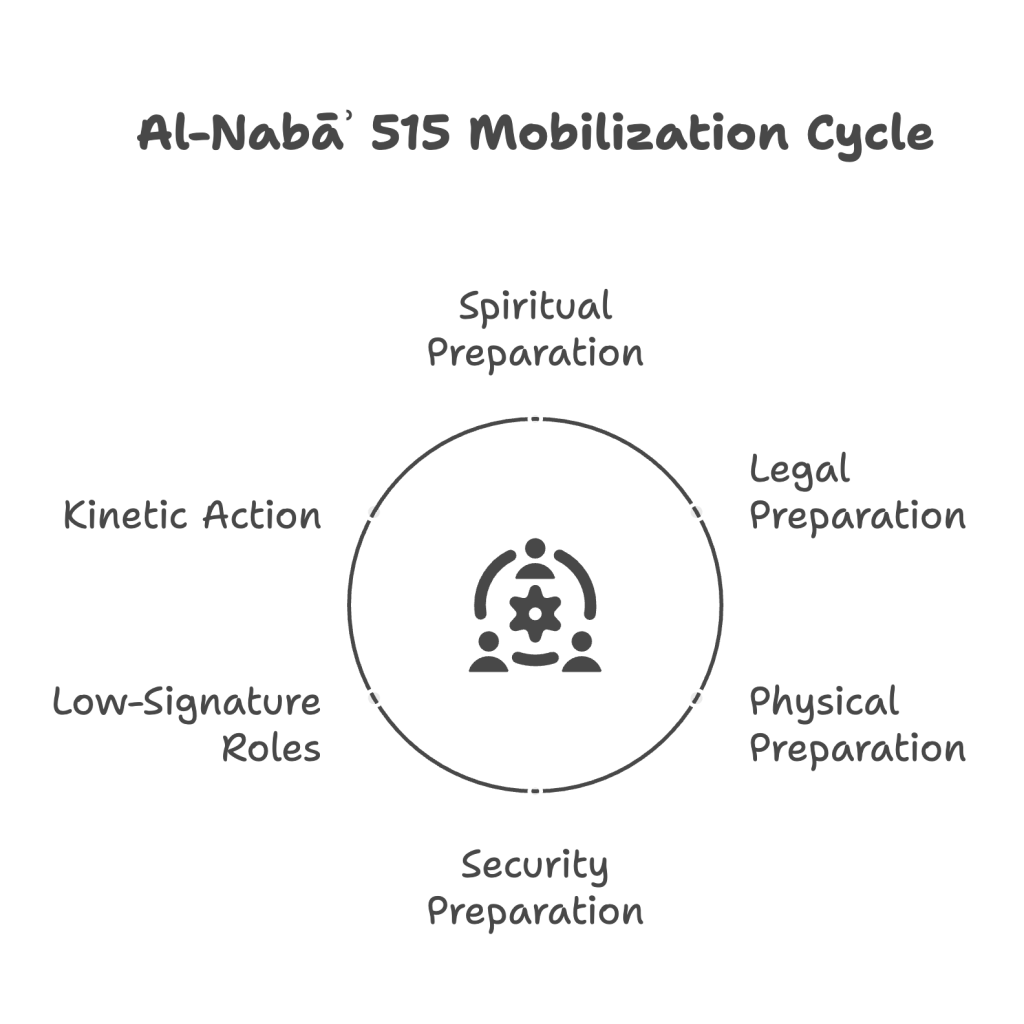
Issue 515 of al-Nabāʾsustains a two-track strategy: a doctrinal reframing that widens who “counts” as mobilized, and an Africa-centered operational story that foregrounds sectarian violence, mobility, and momentum. Syria and Iraq remain present as grievance anchors—especially through the “al-Hawl” revenge motif—while the media craft emphasizes proof-of-life visuals and a stable enemy taxonomy that maps directly onto victim classes and target sets. Together, these elements signal a movement intent on keeping pipelines primed (recruitment, facilitation, logistics) while showcasing Africa as its current center of gravity.
Doctrinal reframing: jihad as continuous preparation
The lead editorial titled sit with the Sitters (“Iqʿudū maʿ al-qāʿidīn!”), recasts preparation (iʿdād) as a standing form of jihad—spiritual, legal, physical, and security-related—stating explicitly that one “is in jihad as long as one is in preparation”: continuous preparation equals continuous jihad. The cadence instructs would-be supporters not to wait for front-line deployment; preparation becomes participation. By stretching the boundary of what counts as “fighting,” the text converts a large pool of sympathizers—many far from a battlefield and under legal scrutiny—into “active” contributors. This lowers the threshold for obedience and raises the ceiling for acceptable, low-signature activity.
The doctrinal move answers several chronic constraints:
- Geographical dispersion and access barriers: By elevating preparation, ISIS keeps far-flung supporters engaged without costly travel or risky handoffs.
- Recruitment friction: It widens the funnel: newcomers can start with prayer circles, study groups, or media dissemination and later graduate to facilitation or clandestine tasks.
- Operational lulls: Recasting quiet periods as a virtuous phase—spiritual, legal, physical, and security preparation—helps bridge gaps between attack cycles without hemorrhaging morale.
- Security pressure: Emphasis on “security preparation” effectively pushes OPSEC and tradecraft (communications hygiene, compartmentation) as religious duty, not mere technique.
Although doctrinal, the Leading editorial is tethered to field stories in two ways. First, it spotlights Africa as the living venue where “preparedness” translates into action; Africa becomes the proof-of-life for the doctrine. Second, it keeps Syria/Iraq as grievance anchors—especially the “vengeance for al-Hawl [camp]” motif—so that supporters can read their preparatory acts as contributions to ongoing moral obligations even if they never reach those fronts.
Africa as operational center of gravity
The densest reporting—and the most triumphalist language—sits in the African wilāyāt, with a pronounced sectarian frame against Christians. Mozambique is presented as a widening battlespace: claims of six churches and over 150 homes burned, with incursions beyond Cabo Delgado toward Nampula, are paired with “documented” visuals to underscore reach and momentum. The narrative stresses mobility (village raids, market-adjacent attacks, secondary-road ambushes) rather than fixed territorial control, communicating a strategy of movement over mass.
In the DRC, a recurring script—highway ambushes against Christian civilians and freight—illustrates an economy-of-violence approach: short, terror-maximizing engagements that also deny economic normalcy. The media pairing of sectarian labels with attack vignettes reinforces the idea of an enemy class, not merely enemy units.
Crucially, the issue highlights a wilāyat Wasaṭ Ifrīqiyā video, “Jihād wa-Daʿwa”, that stitches “Crusader” history to present operations and ends with explicit call to migration (hijra) and jihad. This is not incidental: it couples spectacle (anti-Christian violence) with pipeline activation (recruitment and movement), positioning Africa as both a destination and a stage for future growth.
Syria and Iraq as grievance anchors, not mass theaters
In wilāyat al-Shām/al-Khayr (Deir al-Zūr basin), the “vengeance for al-Hawl camp” motif persists as a moral engine for continued attacks on SDF/“PKK” targets. The framing stresses the protection of imprisoned Muslim women to fuse revenge with social obligation, a blend that historically boosts facilitation and local acquiescence to risk. The tactic pairings highlighted here—ambushes followed by secondary IEDs against relief or reinforcement patrols—are presented as “documented” and replicable, reinforcing standard operating patterns rather than novelty.
In al-Anbār (Iraq), the newsletter’s treatment emphasizes the signal value of adversary responses—notably repeated helicopter evacuations—over battlefield scale, squeezing propaganda yield from limited, opportunistic actions. This keeps Iraq visible as a symbolic arena even when Africa provides most of the kinetic “wins.”
Two media techniques structure the issue’s storytelling:
Documented success as credibility currency: The text repeatedly labels attacks “specialized and documented” and flags Aʿmāq imagery. The effect is to authenticate claims and to provide reusable visuals for downstream propaganda, essential in an era of contested truth and fragmented audiences.
Stable enemy taxonomy as targeting guidance: Labels such as Christians, Crusaders, apostates, and PKK recur across geographies. This taxonomy is not rhetorical excess; it maps directly onto the victim classes foregrounded in the Africa claims and the SDF/PKK focus in Syria, creating a portable glossary of legitimate targets that can be applied in multiple locales.
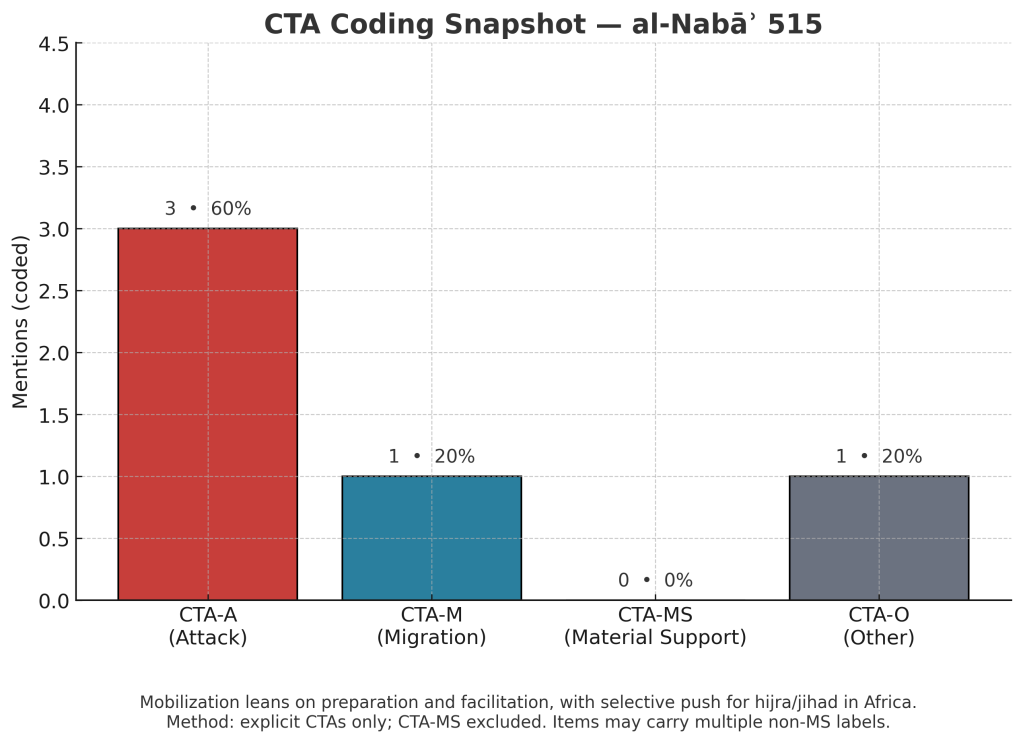
Al-Nabāʾ 515 is less about announcing dramatic breakthroughs than about maintaining momentum and broadening participation. The editorial transforms preparation into duty, keeping supporters in continuous “jihad” even off the battlefield. Africa supplies the kinetic “proofs” and the recruitment pitch; Syria and Iraq supply enduring grievances and repeatable tactics. The media layer—documented visuals and a durable enemy taxonomy—binds these pieces into a coherent, exportable script. For policy audiences, the take-home is clear: expect continued attempts to activate low-signature contributors globally while Africa remains the showcase. Monitoring should prioritize (a) facilitation signals keyed to hijra/jihad appeals in African theaters, (b) narrative uptake of the al-Hawl frame in the Euphrates basin, and (c) the use of “documented” visuals to launder small tactical actions into strategic messaging wins.
[1] Al-Nabāʾ is the ISIS’s official Arabic weekly newsletter, produced by the group’s Central Media Diwan (Dīwān al-Iʿlām al-Markazī) and disseminated primarily via Telegram and affiliated mirrors.
[2] Mukhayyam al-Hawl—often rendered “al-Hol”—is a large displacement and detention camp in Syria’s al-Ḥasakah Governorate. Established in the 1990s, it expanded sharply after the anti-ISIS campaign (2017–2019) to hold tens of thousands of Syrians, Iraqis, and third-country nationals, including many families of ISIS members and detainees. The camp includes an “Annex” for non-Syrian/non-Iraqi women and children.
 ELGOHARI.COM