
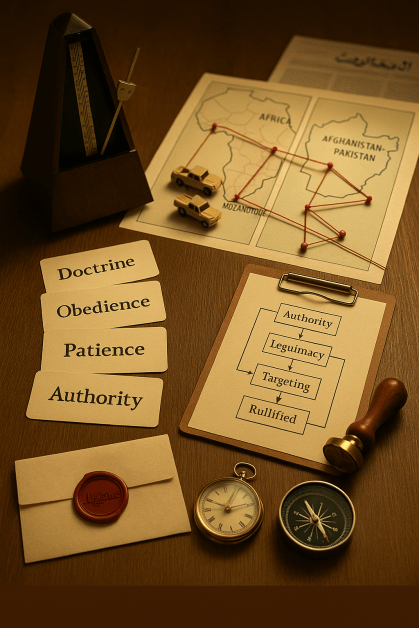
Across October, ISIS and its affiliates told a consistent story about how to wage insurgency without theatrics: doctrine first, tempo over spectacle, and distributed pressure rather than decisive battles. The month’s al-Nabāʾ editorials tightened the link between belief and action, lowering the threshold for “joining the struggle” by reframing preparation (iʿdād) as a standing duty and elevating patience (ṣabr) to campaign doctrine. Field reporting then performed these ideas through a cadence of small, repeatable operations—especially in Africa—while Syria and Iraq served as grievance anchors and continuity stages more than main theaters. Parallel texts from the Islamic State Khorasan Province (ISKP) hardened ideological boundaries, insisting that only allegiance (bayʿah) to a caliphate banner makes violence licit and that cooperation with rival authorities empties struggle of its religious meaning. The net effect is an organization trying to turn time, repetition, and categorical clarity into strategic advantage.
The doctrinal spine is visible issue by issue. Al-Nabāʾ 515 recasts quiet periods and routine training as active participation, converting sympathizers into contributors by moralizing operational lulls. Al-Nabāʾ 516 makes obedience verifiable through deeds; reportage pairs punitive violence with staged outreach to present “jurisdiction” in miniature. By Al-Nabāʾ 518, patience is operational law: accept reversals as trials, keep pressure steady, and let accumulated claims do the narrative work. This sequencing lowers pressure for a dramatic win and prizes momentum that can be sustained across multiple provinces.
Operationally, three motifs stand out. First, corridor and convoy denial in northern Mozambique: by making commerce reliant on armed escorts, insurgents transform state risk mitigation into reputational harm and turn predictable movements into targets. Second, leadership-attrition via IEDs and ambushes in Puntland: fortified posts give way to vulnerable transit, producing a pattern of evacuations that signals fragility without requiring large battles. Third, harassment of administrative “soft nodes” in eastern Syria and intimidation of municipal targets in the DRC/Ituri–Lubero axis: assassinations, arson, and checkpoint attacks communicate that daily order cannot settle. Read together, the month privileges low-cost actions that sap stamina, force security redistribution, and keep the weekly metronome ticking.
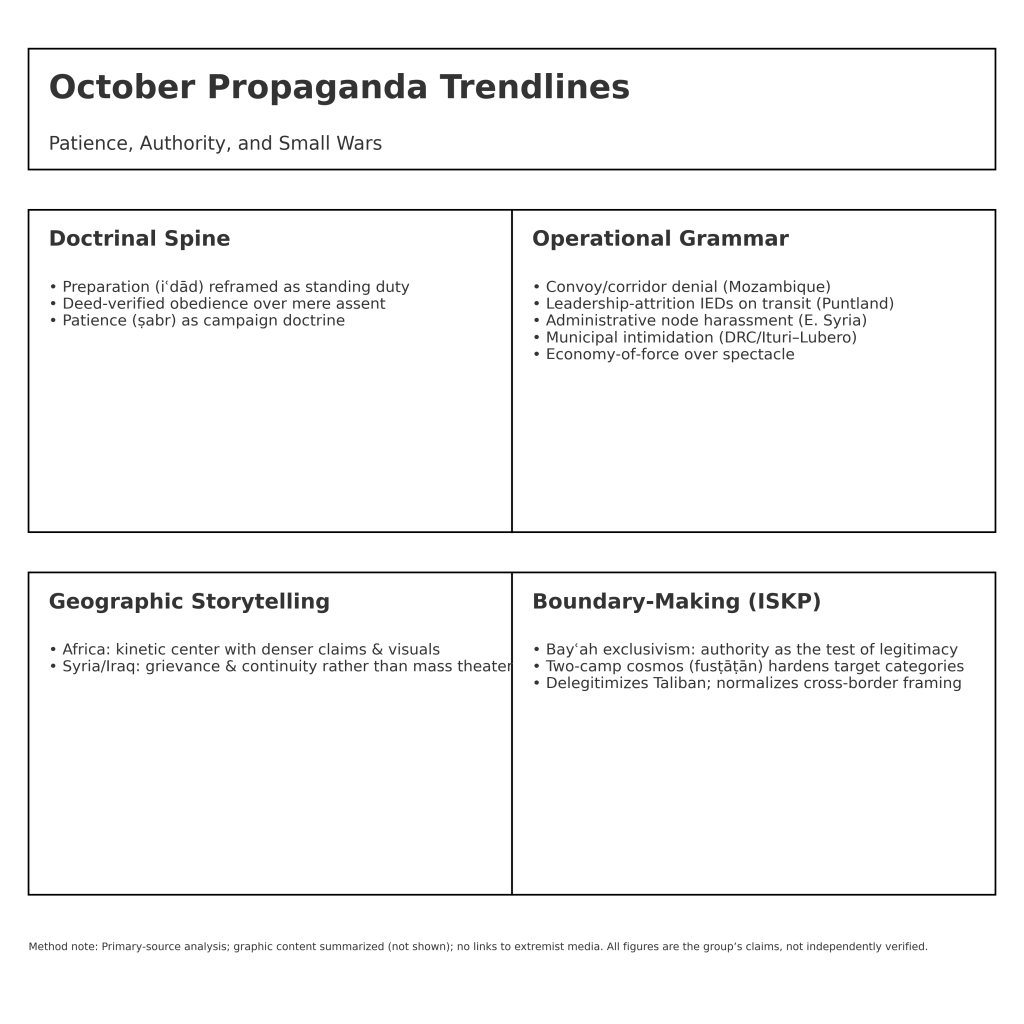
Media craft underwrites this grammar. Al-Nabāʾ 515 leans on a durable enemy taxonomy—“Crusaders,” apostates, and Kurdish “PKK”—that maps cleanly onto victim classes and target sets. The same issue keeps recruitment pipelines warm by spotlighting Africa’s denser claims (and occasional video hooks) while using Syria/Iraq for symbolic value and tactical templates. Al-Nabāʾ 518’s “map-dotting” reinforces tempo even when individual items are thin: the claim stream itself is the message. Across the month, visuals and phrasing are designed for portability; the categories travel, and so do the tactics.
ISKP’s October texts sharpen the ideological edges. “Reclassifying the Battlefield” argues that legitimacy rests on rightful authority rather than battlefield target: fighting “under a blind banner” invalidates otherwise “impressive” operations. Only bayʿah to a caliphate confers lawful jihad. This move delegitimizes Taliban rule, collapses Afghanistan and Pakistan into a single apostate system, and anticipates cross-border operational fluidity. “The Divided Tents of Disbelief and Islam” reasserts a two-camp cosmos (fusṭāṭān), denies gradualism, and recodes cooperation with state or rival Islamist authorities as betrayal of tawḥīd (God’s oneness). The text social-sorts communities and lowers the cognitive barrier to targeting proximate Muslim rivals, all while presenting ISKP’s banner as the sole licit vehicle for struggle in Khurāsān.
The month’s through-lines are clear. Authority and obedience act as gatekeepers, narrowing what counts as legitimate struggle while expanding who “counts” as mobilized. Economy-of-force and distributed tempo take precedence over decisive engagements, rewarding cadres who master friction—not fireworks. Africa remains the center of dynamic storytelling, where claims and visuals sustain momentum; Syria and Iraq operate as grievance engines and continuity stages. Finally, categorical language hardens: stable enemy taxonomies and a two-tents cosmology widen permissive target sets and pre-justify violence against rivals and collaborators.
Monitoring implications: Expect continued convoy friction and route interdiction in northern Mozambique; leadership-focused IEDs against moving units in Puntland; and harassment of administrative nodes in eastern Syria and the DRC. Anticipate ISKP narrative moves that yoke Kabul and Islamabad in a single breath to normalize cross-border attacks. Treat all counts as unverified propaganda outputs, but read tempo and lexicon as intent signals.
The story October tells is not of a movement chasing spectacle; it is of one disciplining patience, clarifying authority, and using repetition to turn small wars into strategic timekeepers. Explore the analyses discussed in this overview:
 ELGOHARI.COM