
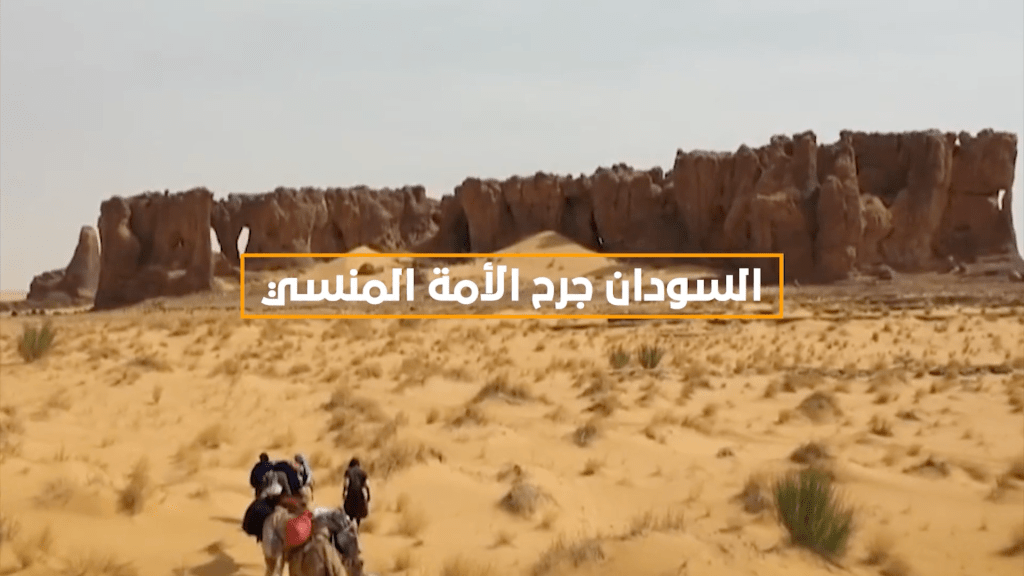
As Sudan’s war grinds on and the humanitarian collapse in al-Fāshir deepens, jihadist actors are moving quickly to seize the narrative. Over the past few weeks, al-Qaida and the Islamic State (ISIS) have treated Sudan less as a conflict to be explained than as a bleeding wound in the body of the Islamic umma—a doctrinal test case and a platform for recruitment, enemy naming, and mobilization. In this analysis, I concentrate on three pieces of propaganda: a statements and a video issued by al-Qaida in the Arabian Peninsula (AQAP) and an editorial from al-Nabaʾ, the ISIS’s weekly newsletter (issue 519).
How Jihadist Media Narrate the Sudan War
AQAP’s written communiqué, “Statement Regarding the Systematic Crimes of Arab Zionists Against Our Muslim People in Sudan,” portrays Sudan as the latest front in a single, continuous assault on the umma. In AQAP’s account, the recent massacres in al-Fāshir are folded into a long-running Zionist-American plot carried out by what AQAP calls “Arab Zionists,” first and foremost the rulers of the United Arab Emirates. In this vision, Sudanese armed actors are not treated as independent parties; the text casts them as “tools” and “mercenaries” serving a scheme whose real authors are Israel, the United States, and the UAE. The communiqué even offers a sequencing story in which Israel purportedly reduced the tempo of operations in Gaza because “the sons of Zayed” could not finance and manage two “Zionist fronts” at once, and therefore initiated a new round of crimes in Sudan. In other words, the communiqué situates Sudan firmly inside AQAP’s existing anti-UAE and anti-normalization narrative.
Another AQAP release is a video called “Sudan: The Islamic Nation’s Forgotten Wound” (al-Sūdān Jurḥ al-Umma al-Mansī), which develops the same narrative architecture in more emotional terms. The video describes Sudan as a “forgotten wound” in the body of the umma and characterizes the violence in al-Fāshir as a “holocaust within a holocaust.” Responsibility is again assigned primarily to external actors: “the emirates of evil” (a label for the UAE), unnamed local proxies, and an “international community” portrayed as structurally indifferent when “Muslim innocents” are killed by its own clients. The script adds an explicitly religious diagnosis: Sudan’s suffering is attributed to Muslims’ abandonment of jihad and their preoccupation with commerce, comfort, and democratic politics. Democracy, secularism, and reliance on international institutions are presented as deceptive exits from crisis and as the very paths that produced humiliation and vulnerability.
The ISIS’s al-Nabaʾ issue 519 frames Sudan differently. Its editorial “Sudan Between Islam and Nationalism” uses Sudan as a doctrinal case study in the clash between “nationalism” and Islamic solidarity rather than focusing on the UAE or particular atrocities. Nationalism is described as a “satanic, jāhilī growth” whose main function is to fragment believers into state-bounded publics trained to view wars like Sudan as “internal affairs.” The editorial claims that this is why large segments of the umma do not experience Sudan as their own wound: they have been conditioned to care only when their own flag is involved. Regimes are depicted as instrumentalizing Sudan as a proxy arena—Abu Dhabi is cited among the actors—but their engagement is framed as driven by national interest rather than solidarity with Sudanese Muslims.
From the ISIS’s perspective, the chief culprit is not a particular government so much as the entire border–sovereignty system (nation-state system) that teaches Muslims to prioritize homeland over creed. The remedy is also conceptual: strip off the “garments of nationalism” and treat Sudan as one limb of a single body, alongside Gaza, Burma, and other fronts. The editorial goes further and describes Sudan as a “turbulent open arena” that young Muslims, especially in Egypt and Libya, should exploit to prepare for jihad, push back “warring apostate armies,” and eventually project force into the “Christian south.” Responsibility for the war is placed on “apostate armies” and the global nationalist order; Sudanese factions are not unpacked, they are subsumed into that category.
Naming the Enemy in Sudan
Across these materials, the enemy architecture converges on a few points. AQAP’s two products assign primary agency to what they label “Arab Zionists,” above all the Emirati leadership, backed by Jews, Americans, and a complicit international system. Sudanese armed actors are largely stripped of independent motives and treated as instruments. The AQAP communiqué sharpens this by calling the UAE a “Zionized micro-state” and mobilizing the figure of Abū Righāl,[1] the archetypal Arab traitor, to mark Emirati rulers as ritual enemies. Al-Nabaʾ 519, by contrast, spreads blame across “nationalism,” “apostate armies,” and regional regimes that use Sudan for national games. There is less fixation on a single Gulf state and more insistence that the underlying problem is allegiance to homeland and constitution rather than to the transnational Islamic bond.
The calls to action are clearer and more alarming than the diagnostic sections. In its Sudan communiqué, AQAP “reaffirms” that Emirati interests, along with those of “Jews and Crusaders,” are legitimate targets “in every place,” and describes the UAE as the enemy’s “eye and hand.” Striking those interests is presented as “the duty of the moment,” and the appeal is not limited to AQAP fighters; it explicitly invites Emirati citizens and “free, honorable” residents inside and outside the Emirates to carry out “any heroic act, great or small.” That is an unusually direct incitement to lone-actor or small-cell violence against Emirati targets globally, with Sudan’s atrocities as the moral trigger.
In the video, the call is more diffuse but still pointed: Sudanese Muslims are told that jihad has been “imposed upon you” and that the “gate of Paradise” has been opened through this conflict. Democracy, secular politics, and negotiations are framed as dead ends; the only acceptable response is to gather around jihad so “the religion is entirely God’s.”
Al-Nabaʾ 519 does not issue a concrete target list, but its call to action is strategic. By urging youth in Egypt and Libya to cast off nationalism and use Sudan as an “open, turbulent arena” for jihad preparation and operations, it casts Sudan as a potential staging ground rather than just a tragedy to be mourned. The mention of extending operations into the Christian south hints at a forward-looking campaign logic: Sudan is envisioned as a hinge theater from which attacks could radiate outward against both local militaries and Christian populations tied, in their narrative, to “Jews and Crusaders.”
Operational Risks Beyond Sudan
The implications of this messaging cut across diplomacy, security, and counter-terrorism. For Sudan-focused diplomacy and humanitarian policy, these materials indicate that jihadist actors are likely to cast any negotiated settlement or international intervention not as progress but as evidence that “false exits” are being reimposed. This does not mean such efforts should be abandoned, but it does mean that external engagement will need credible religious and local interlocutors able to contest the claim that only armed jihad can preserve dignity and rights. Leaving that theological contest unaddressed cedes the discursive space to AQAP and ISIS narratives.
From a security perspective, the regional picture is equally important. The al-Nabaʾ editorial presents Sudan as an “open arena” that can and should be accessed from neighboring states such as Egypt, Libya, and Chad, making cross-border linkages part of the story rather than background noise. Modest movements across the border—whether by traders, youth, humanitarian convoys, or small clusters of volunteers—can be reframed in ISIS messaging as the embryonic stage of a new base of operations.
Taken together, al-Nabaʾ’s portrayal of Sudan as an “open arena” accessible from neighboring states and AQAP’s depiction of it as a shared wound that demands mobilization point to a dual set of indicators. On the physical side, shifts in travel patterns into Sudan’s border regions, especially by young men moving in small groups under vague banners of “support” or “relief,” warrant closer scrutiny. On the informational side, Sudan-linked recruitment narratives in Arabic and local languages—particularly those that stress “shaking off nationalism,” crossing colonial borders, and treating Sudan as part of a single jihad theater—signal intent formation and audience-building rather than background propaganda noise.
AQAP’s communiqué functions as an escalation in rhetoric rather than a change in capability: it sharpens stated intent and widens the set of explicitly invited actors to include Emirati citizens and residents abroad. This kind of incitement raises the risk profile of Emirati diplomatic posts, airlines, and high-visibility commercial assets, particularly in settings where AQAP has an established presence or sympathetic milieu, and should be folded into assessments of exposure to self-initiated or loosely directed attacks.
At a more general level, Sudan’s appearance in these texts underscores how conflicts that the international system already struggles to manage can be reimagined by extremist actors as opportunities rather than tragedies. The more Sudan is allowed to drift into a prolonged, factionalized war with weak accountability for atrocities such as al-Fāshir, the easier it becomes for groups like AQAP and the ISIS to present it as a “forgotten wound” that only their model of transnational jihad is willing—and able—to address.
In narrative terms, Sudan has already been absorbed into the long war that AQAP and the ISIS claim to be fighting. The country’s humanitarian collapse is narrated as proof of hostile architectures—Arab Zionists, apostate armies, and nationalist borders—and as a stage on which new obligations to fight are declared. That framing matters independently of near-term operational shifts: once Sudan is fixed as both wound and launchpad, it can be reactivated whenever a new campaign, attack, or cross-border deployment needs a legitimating story. Monitoring how frequently Sudan resurfaces in their media ecosystems, and which audiences are addressed when it does, will be central to gauging whether this moment marks a rhetorical spike or the start of a more settled script.
[1] Abū Righāl (أبو رِغال) is a stock figure of treachery in early Arab–Islamic lore. Classical narratives portray him as the Arab guide who led Abraha’s army and its elephants toward Mecca; he is said to have died en route near al-Mughammis outside Ṭāʾif, where later generations ritually stoned his grave as punishment for betrayal. Contemporary jihadist media invoke Abū Righāl as shorthand for the “native collaborator” who aids external enemies against the ḥaram and the wider Muslim community.
 ELGOHARI.COM