
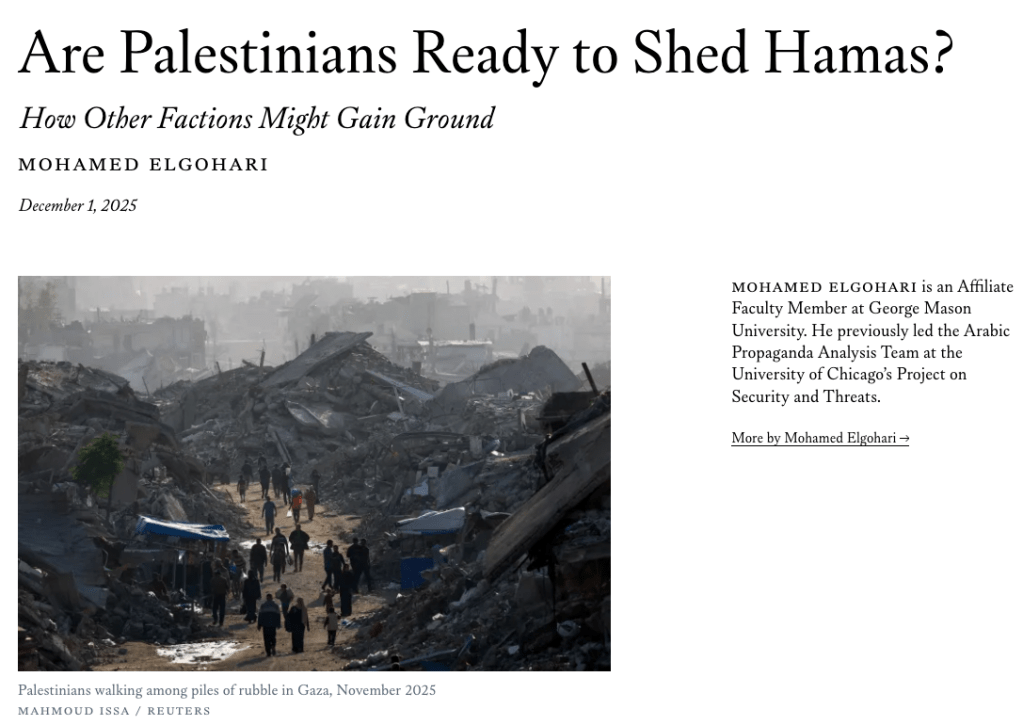
Foreign Affairs carried my essay distilling eight PSR waves into a simple map of Palestinian opinion—what moved, what didn’t, and why it matters for policy. The piece asks a deceptively simple question—what do Palestinians actually want right now?—and answers it with evidence from the Palestinian Center for Policy and Survey Research’s nationally representative surveys conducted before and after October 7. Rather than treating “support for Hamas” as a fixed quantity or a proxy for all political preferences, I reconstruct a two-year opinion arc: an initial post–October 7 rally, a subsequent correction as the costs of war mounted, and, by 2025, a re-pluralization in which Hamas still places first but no longer commands a governing mandate. That arc is not linear, and it differs across Gaza and the West Bank, but its shape is consistent enough to anchor policy choices rather than chase headlines.
The essay begins with the core standing indicator—who is “most deserving to represent and lead”—to show how a late-2023 majority for Hamas contracted to a first-place plurality. It then tracks how presidential and parliamentary trial heats moved in parallel. Head-to-head, Hamas nominees retain an advantage against Mahmoud Abbas; introduce a credible reformist alternative, notably Marwan Barghouti, and the race flips while participation rises and the “neither/undecided” space shrinks. The point is not that opinion swings wildly; it is that authorizing cues and perceived credibility matter. Where there is a real choice, abstention falls and competition normalizes.
The middle of the piece examines the “day after” in Gaza, because governance preferences are where attitudes become operational. A straightforward return to full Palestinian Authority control attracts limited enthusiasm. By contrast, a Palestinian-led committee of experts tasked with administration and reconstruction—supported by international partners in a civilian, auxiliary, time-bound role—earns broad acceptance, particularly in Gaza. That asymmetry is not accidental. Gazans, living with mass casualty, displacement, and physical destruction, tie legitimacy to visible delivery: predictable aid, honest contracting, and site-level progress they can see. West Bankers, under routine exposure to raids, settler violence, and economic restrictions, remain more skeptical of political formulas absent material changes in daily security.
External roles track the same logic. A proposed armed Arab force with a disarmament mandate is widely rejected. Narrow the mission to border security and internal order, coordinate with local police and a Palestinian experts’ committee, and remove any disarmament clause; acceptance rises, especially in Gaza. The design lesson is simple: assistance that enables Palestinian leadership can gain cover; assistance that replaces it cannot. Strategy preferences to end the Israeli occupation—armed struggle, negotiations, peaceful resistance—have diversified. Armed struggle remains the most frequently chosen single option, but non-violent tracks in aggregate now outnumber it. This is not a wholesale conversion to diplomacy. It is a pragmatic recalibration: when diplomacy is paired with tangible delivery and a credible administrative path, negotiations are viewed as workable rather than wishful. The same pairing also narrows the feasibility gap around a two-state outcome: skepticism remains high, but practicality rises when the policy environment stops punishing moderation.
The final section turns from diagnosis to prescription. Early deliverables are not logistics; they are political interventions. Make the cease-fire felt—calmer streets, predictable aid delivered by UN-coordinated convoys, orderly exchanges, and a reconstruction plan the public can audit—and the trend toward negotiations consolidates. I propose a public reconstruction ledger (portal, interactive map, or weekly bulletin) that lists contractor awards, timelines, neighborhood-level progress, and grievance filings with resolutions, audited by international observers. Transparency of that sort speaks directly to corruption concerns and converts skepticism into conditional support for Palestinian-led administration. In parallel, define any external roles clearly and keep them civilian and time-bound so that governance remains anchored in Palestinian leadership.
The West Bank and Gaza require differentiated approaches. Measures that build legitimacy in Gaza—relief corridors, reconstruction, and non-predatory civilian policing—will not automatically persuade West Bankers unless there is a demonstrable reduction in daily exposure to raids and settler violence and credible channels for complaints that produce visible outcomes. Trying to fold both populations into a single template risks discrediting the transition on both sides. Elections, finally, should follow minimum conditions—freedom of movement, media access, and baseline policing guarantees—so that results reflect choice rather than the capacity to mobilize under pressure. Sequencing them behind administrative stabilization is not a dodge; it is the only way to produce a mandate that can govern.
Across these threads, the through line is straightforward. October 7 and the humanitarian toll explain a great deal, but they do not explain everything. Palestinian preferences track who leads, how alternatives are framed, and what is delivered. A cease-fire that is felt—not just announced—expands the political center and creates space for Palestinian-led governance backed by limited, civilian international support. A cease-fire that lives only on paper returns the field to coercion and re-polarization. The essay lays out both paths and the indicators to watch in the weeks ahead. Read full analysis here.

