
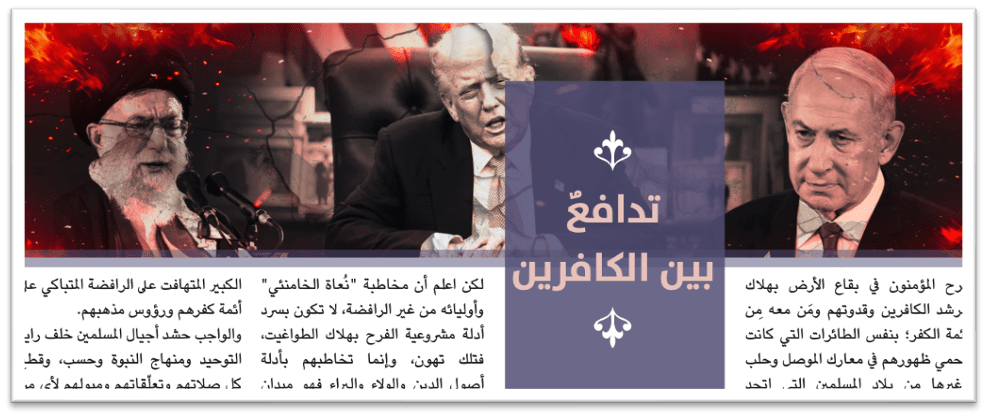
The U.S.-Israeli assassination of Iran’s Supreme Leader Ayatollah ʿAlī Khāmenīʾī on 28 February 2026 did not only decapitate the Islamic Republic’s leadership — it handed the Islamic State its most potent propaganda opportunity since the fall of Mosul. Within days, the group released two coordinated texts: the lead editorial of its central weekly newsletter al-Nabāʾ No. 537, and a dedicated 16-page congratulatory statement by its Khurāsān Province (ISKP). These documents reveal a group that is strategically alert, ideologically disciplined, and actively converting regional chaos into operational capital.
Two Documents, One Strategic Logic
The two publications function as a deliberate two-tier response. Al-Nabāʾ frames the assassination within a broad geopolitical narrative intended for ISIS’s worldwide constituency and directed polemically at rival Islamist movements. The ISKP statement is a targeted, operational document aimed at Muslims in Fārs and Khurāsān, converting that geopolitical narrative into an explicit call to mobilize against a weakened Iranian state. They reflect a single underlying strategic logic — but one that operates simultaneously at the level of global ideology and local action.
Both documents converge on the same reading of the assassination. The US-Israeli killing of Khāmenīʾī is not, in ISIS’s framing, an act of Western imperialism to be resisted, but evidence that God is turning the group’s enemies against one another — a divinely sanctioned clearing of the battlefield. For ISIS, the assassination confirms its long-standing argument that the Shiʿi-led “resistance axis” was never an ally of Islam but a participant in the same system of kufr as the West. That Khāmenīʾī was killed by the same American warplanes that once “protected the backs” of Iranian-backed militias in Mosul and Aleppo is, in the group’s framing, a supreme geopolitical irony — and a potent recruitment script.
What makes both documents analytically significant beyond their immediate content is what they reveal about ISIS’s current mobilization logic. Both argue that the present moment of geopolitical disruption — the US-Russia confrontation over Ukraine, the Israeli degradation of Hezbollah and the broader Iranian proxy network since 2024, and now Khāmenīʾī’s death — represents a structural opening for jihadist groups that has not existed since the territorial caliphate’s defeat. The group is not claiming credit for these developments. It is claiming they confirm its worldview and create conditions its fighters should exploit. This is a materially different framework from the 2014–2019 period, when the primary mobilization call was hijra — migration to territory.
The geopolitical analysis embedded in both documents is also notable for what it predicts about the evolving regional order. The al-Nabāʾ editorial argues that Iranian strikes on Gulf states — which escalated in the immediate aftermath of Khāmenīʾī’s death — will accelerate normalization between Gulf populations and Israel, not only at the official level but among publics. This is presented as a dangerous drift that ISIS intends to counter. The editorial explicitly warns Muslim audiences against aligning with either the “Crusader-Israeli aircraft” or the “Iranian missile,” framing any movement in that direction as theological betrayal. This is ISIS attempting to close off the political space that the current conflict might otherwise open — particularly in Gulf states where public opinion on normalization remains volatile and susceptible to rapid realignment.
The most operationally consequential dimension of the two documents, however, is the Persian-language targeting of the ISKP statement. ISKP’s decision to release a dedicated Persian-language text within days of the assassination, addressed specifically to “monotheists in the lands of Persia,” reflects a sustained and deliberate effort to build influence among Sunnī minority communities inside Iran: Balūch communities in Sīstān wa Balūchistān, Arab Sunnīs in Khūzistān, and the large Afghan Sunnī population resident in Iran — estimated in the millions and largely holding precarious legal status. These communities carry specific grievances against the Islamic Republic that predate the current crisis, and ISKP has documented operational networks in the Afghanistan-Pakistan-Iran border zone that could plausibly support action in the current environment. The succession crisis, ongoing military confrontation, mass protests, and accelerating economic collapse that Iran is simultaneously managing represent precisely the kind of institutional stress that historically correlates with increased vulnerability to jihadist recruitment and attack.
Targeting the Resistance Axis’s Legitimacy
The most strategically significant dimension of al-Nabāʾ‘s editorial is not its celebration of Khāmenīʾī’s death but its aggressive targeting of Sunni Islamists who mourned it. The editorial devotes considerable space to denouncing what it calls nuʿāt al-Khāminīʾī — Sunni “mourners of Khāmenīʾī” — accusing them of fundamental ideological capitulation rather than mere political miscalculation. This is a direct attack on the Hamas-Iran relationship, on Muslim Brotherhood-aligned movements, and on any Sunni actor whose opposition to US-Israeli power had led them to tactical solidarity with Tehran.
The timing is devastating. With Hezbollah structurally depleted, the Houthis under intensifying US pressure, Hamas’s Gaza operation in a prolonged attrition phase, and now Khāmenīʾī dead, the ideological scaffolding of the “resistance axis” has fractured precisely when its Sunni partners most needed it intact. ISIS’s editorial exploits this fracture, framing Iran’s collapse of patronage as vindication of its two-decade argument that partnership with the rawāfiḍ was always a theological and strategic betrayal. The intended audience — disillusioned Sunni militants who invested in the resistance framework — is now being offered an ideological exit ramp toward IS.
The Khurāsān Statement: Converting Narrative into Operations
Where al-Nabāʾ operates at the level of strategic messaging, the ISKP Khurāsān statement is explicitly operational. It calls directly on muwahhidūn inside Iran to “not be negligent” and to “be ready for opportunities to strike” during a moment of regime vulnerability. This is a time-sensitive mobilization call calibrated to the window between Khāmenīʾī’s assassination and consolidation of the successor regime — a period the IRGC is spending on internal succession politics, retaliatory planning against the US and Israel, and managing the shock of losing a leader who held power for 35 years.
The statement also frames the post-assassination moment as an opportunity for ISIS prisoner liberation from Iranian jails, tying the geopolitical event to a highly personal and emotive grievance within the ISIS community.
This is a sophisticated mobilization tactic. It converts an abstract geopolitical victory into a concrete, actionable mission with a human face.
What This Means for the Conflict
For the broader US-Iran confrontation, ISIS’s response introduces a third-actor dynamic that neither Washington nor Tehran is well-positioned to manage. The IRGC, its attention divided between succession, reprisals, and proxy reconfiguration, faces elevated internal threat exposure from ISIS cells that ISKP’s statement is actively inciting. Meanwhile, US and Israeli planners who executed the strike on Khāmenīʾī must now reckon with the accelerant effect their action has had on the ISIS propaganda cycle — the assassination that was meant to weaken the Iranian threat has simultaneously energized a separate and durable threat architecture.
For the wider MENA region, ISIS’s framing of the conflict as mutual kāfir destruction creates what al-Nabāʾ explicitly calls tamāyuz — a polarization event that sorts Muslim communities into camps and generates ISIS’s preferred recruitment conditions. The editorial warns, with strategic clarity: “Beware the emergence of jāhiliyya banners — one side under the name of toppling the Iranian regime, another under the name of resisting the Crusader campaign.” ISIS is positioning itself as the only legitimate alternative to both poles, targeting the large segment of Muslim publics who are neither pro-Iran nor pro-American.
Predictable Patterns
Several trajectories now become analytically foreseeable. First, ISKP will almost certainly escalate operational activity in eastern Iran and the Afghanistan-Pakistan borderland during the IRGC’s transition period, exploiting reduced Iranian counterterrorism bandwidth. Second, ISIS’s central apparatus will intensify messaging targeting Sunni Islamist movements — particularly those with organic connections to Iranian proxy networks — aiming to peel away alienated members during what is likely the resistance axis’s deepest crisis of legitimacy. Third, ISIS will work to position the month of Ramaḍān as a symbolically charged mobilization window — using the month’s elevated religiosity to amplify the call to action.
Longer term, if the IRGC succession under Mojtaba Khāmenīʾī produces internal friction or a visible weakening of Iran’s regional proxy network, ISIS’s strategic calculus of tadāfuʿ will be empirically reinforced in its supporters’ eyes — making its narrative self-fulfilling and its propaganda correspondingly more effective.
These two publications highlight a consistent ISIS strategic reflex: the group does not need to fight in a conflict to exploit it. By converting a US-Israeli strike into an ISIS victory narrative, by attacking the credibility of rival Islamist movements at their most vulnerable moment, and by issuing operationally specific mobilization calls under the cover of theological justification, IS has extracted maximum strategic value from an event in which it played no part.
The assassination of Khāmenīʾī was intended to reshape the regional balance of power. In ISIS’s reading, it has — and not entirely in Washington’s favor. It has not fundamentally changed ISIS’s strategic position. The group remains territorially degraded, organizationally dispersed, and under sustained military pressure across every theater where it operates. What the assassination has done is give ISIS’s existing strategic narrative its most significant external validation since the group’s territorial defeat. The group has consistently argued that the regional order constructed to contain it was a coalition of convenience whose contradictions would eventually destroy it. As of March 2026, that argument is harder to dismiss than it was a year ago. Whether ISIS can translate ideological validation into operational momentum is the question the coming weeks will begin to answer.

