
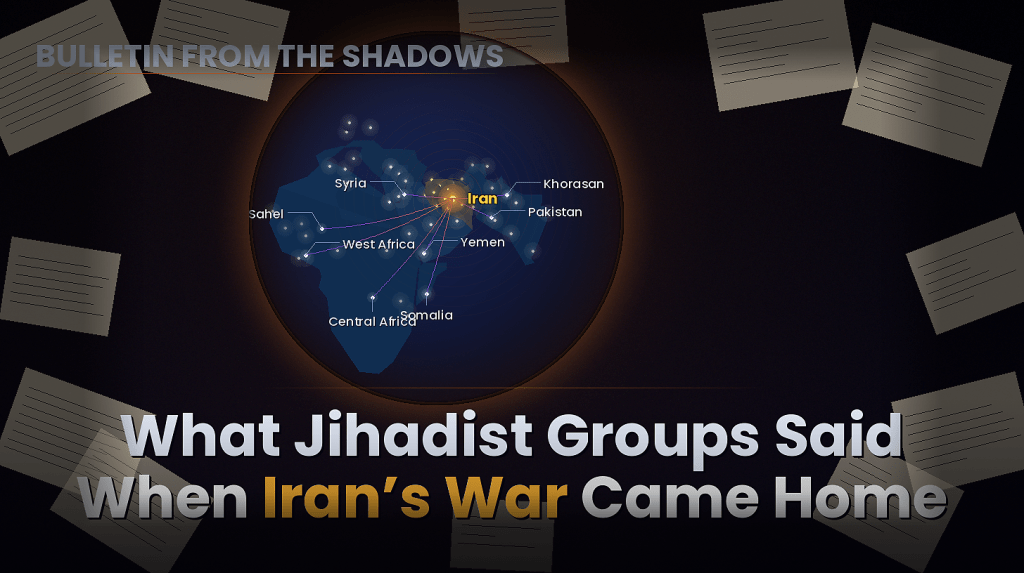
The month of March 2026 gave jihadist and militant organizations an unusually dense geopolitical moment to work with. The reported death of Iranian Supreme Leader ʿAlī Khāmanaʾī, the war between the United States, Israel, and Iran, and the continuation of the war in Gaza all landed simultaneously in the propagandists’ in-box.
The Dominant Story
When Khāmanaʾī’s death was reported, jihadist groups did not respond uniformly — but they responded through strikingly similar doctrinal vocabulary. ISIS and its Khurāsān affiliate (ISKP) celebrated the event as an act of divine justice, deploying a classical Islamic concept called tadāfuʿ — the idea that God sometimes sets wrongdoers against each other as punishment and mercy for believers. Both organizations anchored their arguments in the same Quranic verses and cited overlapping lists of classical scholars. They did this independently, in Arabic and Persian respectively, within the same week.
This convergence without coordination is analytically significant. It points to a shared conceptual infrastructure across the jihadist world — a common doctrinal toolkit that different organizations draw on when processing the same external events. When two organizations with no operational relationship produce nearly identical theological arguments in different languages within days of each other, it tells us something about how ideas travel across the jihadist ecosystem even in the absence of direct coordination.
At the same time, the groups diverged sharply on what Muslims should actually do about the crisis. That divergence is just as analytically important as the convergence.
ISIS: A Four-Week Editorial Argument
ISIS’s al-Nabāʾ editorials form a coherent sequence in which each one advances the argument a step further.
The first editorial (issue 537) establishes the doctrinal frame. Neither the Iranian-Shia camp nor the American-Israeli camp deserves Muslim support, and Shia influence is, in the editorial’s view, the more immediate threat to Muslim communities. The second (issue 538) identifies who corrupted Muslim judgment — Gulf and Arab religious scholars who previously condemned ISIS’s targeting of Arab armies, but who now quietly endorse Iranian strikes on those same armies. The third (issue 539) converts the argument into an action program. Ramaḍān’s elevated operational pace should be sustained into the next sacred season, Dhū l-Ḥijja (the Hajj season, approximately June 2026). The fourth (issue 540), released after ʿĪd, locks the argument down epistemologically. Loyalty and disavowal should derive from scripture, not from cable news or geopolitical analysis.
The underlying West Africa military campaign — formally named the “Ramaḍān Camp-Burning Campaign” in issue 538 — ran simultaneously. ISIS claimed 81 operations and 359 killed or wounded across the full month of March, across seven countries from Nigeria to Pakistan. These are group claims only; none has been independently verified. The most notable single claimed operation was a suicide vehicle bombing in Nigeria’s Sambisa Forest, the first of its type in West Africa in the available recent record. ISIS also claimed for the first time an attack on a Chinese mining complex in the Democratic Republic of Congo, targeting both Congolese soldiers and the mine’s infrastructure — a novel target type in the Central Africa theater.
AQAP: Two Products, Two Audiences
Al-Qaʿidah in the Arabian Peninsula released two very different products in March, and the contrast between them is instructive.
The first is a Ramaḍān Arabic tract urging Muslim youth toward learning, preparation, and support for militant networks — citing, strikingly, named online learning platforms including Coursera, Udemy, and edX as tools for acquiring scientifically useful knowledge in service of armed struggle. The release addresses not only potential fighters but also scholars, tribal leaders, and community notables, pressuring them to move beyond rhetorical sympathy into material support for jihadist networks. This is ecosystem-building propaganda: long-horizon, audience-broadening, concerned with infrastructure rather than immediate violence.
The second is Inspire Guide #12, an English-language magazine celebrating a claimed attack on a Hanukkah gathering at Bondi Beach, Sydney — attributed to two brothers, one killed and one imprisoned — and explicitly inviting Muslims living in the United States or Europe to repeat what they did. The call to action is unambiguous. The magazine packages biography, theological justification, claimed tactical lessons, and instructional content into a single emulation script aimed at Western-based readers radicalized by the war in Gaza. It is the most operationally direct incitement product in the March corpus.
Together, the two releases describe an organization running parallel strategies for different segments of a tiered constituency: slow ecosystem-building in Arabic, fast lone-actor incitement in English.
State Legitimation, Army Delegitimation, Minority Solidarity
Al-Qaʿidah in the Indian Subcontinent (AQIS) released a statement on Pakistani air strikes in Kabul that is notable for its precision. It does not celebrate violence; it argues that Pakistani Air Force pilots who carried out the strikes bear personal moral and legal responsibility for civilian deaths, cites a named religious ruling to that effect, and calls on scholars and political leaders to publicly break with the military. It is an army delegitimation product dressed in legal-religious language, aimed at creating defection pressure within Pakistani military institutions. Alongside it, AQIS published a ninety-page Urdu magazine combining Ramaḍān devotional content, Gaza-centered grief, anti-blasphemy rhetoric, and geopolitical analysis — an ideological conditioning product designed to make militancy feel like the natural conclusion of correct belief, rather than a separate and alarming departure from it.
The Islamic Emirate of Afghanistan’s Arabic-language monthly magazine (al-Ṣumūd, issue 243) performs a different kind of political work entirely. It presents the Taliban government as a sovereign, competent, and diplomatically engaged state — documenting trade agreements with Uzbekistan, improving relations with Russia, currency stability attributed to Islamic governance, and the release of Pakistani prisoners through Saudi mediation. The framing of Pakistan as a reckless aggressor who violated diplomatic norms is sharper than in recent issues, with implications that extend beyond militant propaganda into regional diplomatic dynamics.
Finally, Jabhat Mubārizīn Mardamī, a Baluch-Iranian insurgent group, released a Persian ʿĪd statement mourning civilians killed in the Iranian war while systematically assigning blame to the Iranian regime rather than to the United States or Israel. Its most analytically notable feature is its dual address. It speaks simultaneously to “the Iranian nation” and to “the suffering Baluch nation,” suggesting an effort to nationalize a historically subnational insurgency by joining Baluch suffering to a broader Iranian anti-regime narrative.
The Bigger Picture
Taken together, the March corpus illustrates several patterns that are likely to persist.
First, Gaza remains the central emotional and legitimizing reference point across the entire jihadist landscape, regardless of geographic theater or organizational identity. Every group in the corpus invokes Palestinian suffering, even those — like AQIS and the Taliban — whose primary operational concerns lie elsewhere. Gaza has become a universal entry point.
Second, the scholar-as-target is a theme worth watching. ISIS’s editorials, AQIS’s Kabul statement, and AQAP’s Arabic tract all invest significant effort in delegitimizing establishment religious figures — characterizing them as agents of corrupt rulers, cowards, or hypocrites whose opinions on who Muslims may and may not fight are not binding. This sustained attack on institutional religious authority creates a vacuum that these organizations are simultaneously trying to fill with their own daʿwah (religious outreach) programs.
Third, the multilingual expansion of this cycle — English for Western audiences, Persian for Iran and Central Asia, Urdu for South Asia, Arabic for the broader Muslim world — reflects a deliberate effort by several organizations to reach new constituencies rather than simply intensify messaging to existing ones. ISKP’s Persian-language tract and AQAP’s English guide are both first-of-type products in the available recent record. New language investments often precede new audience-targeting campaigns.
The full March 2026 issue of BFTS, including individual release analyses, cross-group thematic comparisons, and operations claims tracker, is available upon request. You may email your requests to melgohari@elgohari.com

