
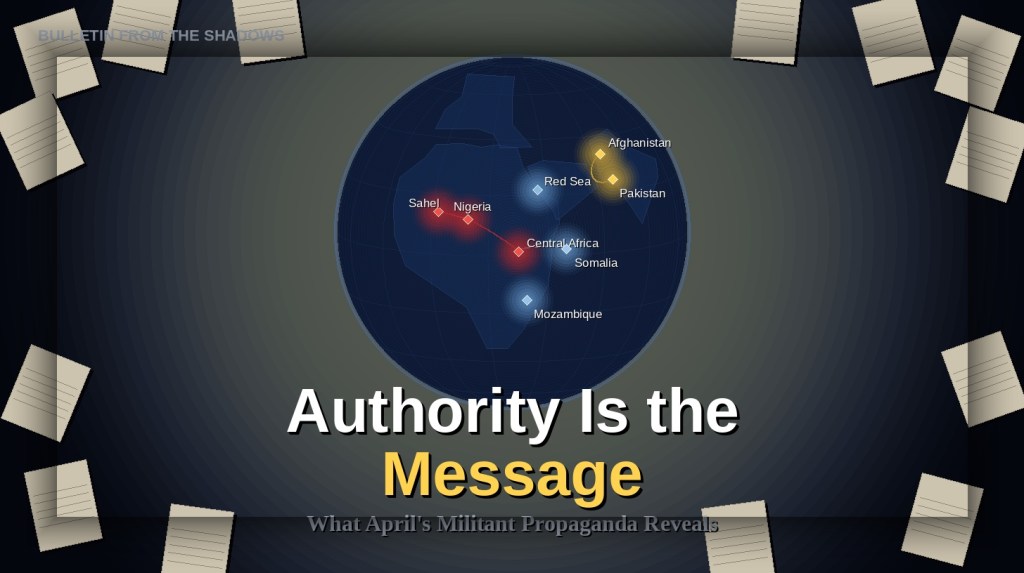
In April 2026, militant propaganda did not simply announce violence; it staged a contest over authority. The dominant investment across the cycle is not violence. It is authority: who has the right to govern, adjudicate, administer, and define what counts as legitimate Muslim political action. Across ISIS, ISKP, the Islamic Emirate of Afghanistan, and al-Shabāb, the most important question was not only who could strike, but who could govern, punish, provide, interpret Muslim suffering, and define legitimate political action. The month’s releases show organizations competing not only on the battlefield, but also over law, sovereignty, public welfare, doctrinal credibility, and the emotional economy of Muslim solidarity. That shift, playing out simultaneously and independently across very different organizations, is the most significant finding of this month’s monitoring.
That competition is visible across sharply different media forms. Taliban statecraft in al-Ṣumūd, al-Shabāb’s administrative reporting, ISIS’s weekly al-Nabāʾ claims from Africa, and ISKP’s polemics against the Taliban, Turkey, and Pakistan. Each actor uses propaganda to answer the same political question in a different way: what makes an armed Islamic actor legitimate? For the Islamic Emirate, legitimacy comes through sovereignty and state capacity. For al-Shabāb, it comes through insurgent administration and judicial authority. For ISIS and ISKP, it comes through uncompromising doctrine, takfīr, violence, and the claim to enforce divine law against all rival orders.
Three Organizations, Three Theories of Legitimacy
The most consequential cross-group pattern in April’s corpus is the convergence on governance-claiming propaganda across three distinct organizational contexts — each advancing a different theory of what makes an armed organization legitimate.
The IEA’s al-Ṣumūd magazine (Issue 244) presents the most developed version, governance as statehood. Anchored on the alleged Pakistani airstrike on Omid Hospital in Kabul — a claim that must be treated as the IEA’s own, not an independently verified fact — the issue does not stop at condemning civilian harm. It folds that condemnation into a comprehensive argument for Afghan sovereignty, economic self-reliance through infrastructure projects and regional trade corridors, anti-corruption administration, Islamic jurisprudence-based diplomacy, and a carefully calibrated deterrence posture. Defense Minister Muḥammad Yaʿqūb Mujāhid’s warning — if Kabul is made unsafe, Islamabad will not remain safe — is presented not as a threat but as a restrained and proportional response from a recognized governing authority. The IEA refuses formal takfīr of Pakistan, treating it instead as a Muslim neighbor in conflict. That restraint is deliberate and strategic. a governing state that must manage inter-Muslim relations cannot afford the apostasy categories available to a transnational insurgency.
Al-Shabaab’s five monthly news reports present a second theory, governance as insurgent administration. The reports are structured as daily operational logs, but buried within the attack tallies are claims of a different kind; a drought relief committee with formally enumerated responsibilities, clan reconciliation proceedings mediated by the Office of Politics and Provinces, a Qurʾān memorization competition held across eleven claimed “Islamic provinces,” and moon-sighting decisions issued by a judiciary office. The formation of a drought relief committee with stated duties for needs assessment, coordination, distribution verification, and reporting is not incidental content. It is a claim to administrative authority. Al-Shabaab is not merely fighting the Somali state; it is presenting itself as replacing it, service by service and function by function.
ISIS’s Central Africa reporting offers a third theory, governance as divine-law enforcement. Across Issues 541–544 of al-Nabāʾ, the group claims that Christian prisoners in Ituri were released after paying jizya “while humbled” (ṣāghirīn), that two alleged “sorcerers” in Borno were sentenced to death by sword after referral to a sharīʿa court, and that ISIS fighters in the Congo and Nigeria are not merely raiding communities but administering an Islamic legal order over non-Muslim populations. Whether these specific claims are accurate is a separate empirical question. The propaganda investment in them is not accidental.
These groups are not simply claiming to have struck their enemies. They are competing for the right to rule, adjudicate, and provide — and they are doing so through different mechanisms that reflect genuinely different organizational theories of legitimacy. For anyone thinking about how to contest these organizations’ authority, that distinction matters. Responses focused on discrediting attack claims will leave the governance argument entirely uncontested.
The Intra-Field Confrontation: ISKP vs. the Taliban
The cycle’s most direct propaganda collision is between the IEA’s governance-and-statehood frame and ISKP’s rival-delegitimation campaign. ISKP makes three targets central: Turkey under Erdoğan, Pakistan’s military establishment, and the Taliban/Islamic Emirate of Afghanistan. Each is accused of combining Islamic language with service to unbelievers. Each is formally declared apostate (murtadd). The Taliban section is the most directly competitive. It frames the Islamic Emirate not as a flawed Islamist government but as a “cheap intelligence institution” serving the world’s unbelieving powers, pointing to the Doha Agreement, alleged protection of Shiʿa gatherings, and cooperation with China, Russia, and India as evidence.
The two releases — al-Ṣumūd 244 and the ISKP pamphlet — present irreconcilable claims to the same Afghan and Persian-reading audience. The IEA says it is a legitimate Islamic state under unjust foreign attack. ISKP says it is an apostate proxy of global unbelief. There is no middle ground between these positions. The outcome of this contest has concrete consequences. If the IEA’s governance frame consolidates successfully, ISKP is reduced to a residual insurgent position with limited recruitment space. If ISKP’s delegitimation frame gains traction — particularly among Afghan youth disappointed by Taliban governance failures — conditions for ISKP escalation improve materially.
The pamphlet also activates the most operationally consequential language in the cycle outside al-Nabāʾ. It explicitly declares that jihād against Pakistan’s military is farḍ ʿayn — an individual religious obligation — and calls on Muslims to oppose apostate regimes “with sword and pen.” This, combined with the continuing IEA–Pakistan escalation over airstrikes, makes the Afghanistan–Pakistan border zone the most analytically live threat indicator in the cycle.
Africa, Nigeria, and a Preemptive Framing Strategy
Across ISIS’s four weekly newsletters, sub-Saharan Africa dominates both operationally and editorially. The claimed attacks — concentrated in Nigeria’s Borno State, Ituri Province in the DRC, the Niger–Mali–Burkina Faso triangle, and Mozambique’s Cabo Delgado — are group claims that remain largely unverified in available open-source reporting. But the propaganda investment goes beyond battlefield reporting. The editorials increasingly absorb Africa into the moral architecture of the newsletter. Nigerian Muslim civilians are cited as a test case for whether Muslim solidarity is doctrinally authentic or corrupted by trend-driven and state-managed outrage. That elevation of Africa from operational theater to moral indictment of the global Muslim audience is a more ambitious project than any single attack claim.
The most consequential specific passage in the April corpus — outside the Sydney attack invocation in Issue 541, which warrants independent tracking — appears in Issue 544. The editorial argues that Muslim publics will notice Nigeria only when explosions reach Abuja and similar urban centers, but that their sympathy at that point will go to the state’s soldiers rather than to the Muslims the state allegedly killed. This should not be read as passive prediction. It is a preemptive framing strategy. It’s an attempt to define future urban violence in Nigeria as just response before it occurs, and to delegitimize any public sympathy for state casualties in advance. The editorial is preparing the audience’s interpretive framework for an escalation that has not yet happened. That is analytically distinct from routine attack-claim propaganda, and it warrants monitoring in subsequent issues.
What Connects These Organizations and What Divides Them
The doctrinal vocabulary running across all four actor groups in April is more consistent than their organizational differences would suggest. The boundary-construction logic of al-walāʾ wa-l-barāʾ — loyalty to believers and disavowal of unbelief — appears across all four groups, though sometimes as explicit formulation and sometimes as structural practice through enemy taxonomy. Classical scholarly citation is notably dense across the cycle. ISIS’s al-Nabāʾ cites Ibn Rajab al-Ḥanbalī, Ibn al-Qayyim, Ibn Kathīr, al-Qurṭubī, and al-Nawawī; the IEA’s al-Ṣumūd invokes Abū Ḥanīfa and contemporary fatwa authorities; al-Shabaab’s reports invoke Qurʾānic framing for judicial punishment. These are not decorative citations. They are credentialing strategies — attempts to position organizations not as revolutionary innovators but as transmitters of recognized classical authority.
The most consequential divergence is over takfīr — the religious declaration that a Muslim is an unbeliever and therefore a legitimate target for violence. ISIS applies it routinely to Nigerian, Congolese, Pakistani, Syrian, and al-Qaʿida-linked forces. ISKP applies it explicitly and centrally to the Taliban, Turkey, and Pakistan. Al-Shabaab applies it to the Somali government and its forces. The IEA, by contrast, refuses it entirely in this cycle, even while condemning Pakistan’s military sharply. This restraint is not doctrinal weakness; it is strategic positioning by a governing authority that cannot afford to apostasize its neighbors. Understanding which organizations apply takfīr broadly, which apply it selectively, and which refuse it is analytically essential for mapping the field’s internal boundaries.
The Broader Picture
April’s propaganda cycle illustrates a landscape in which the contest is no longer primarily over who can claim the most dramatic attacks. The more consequential competition is over administrative authority, doctrinal legitimacy, and the management of Muslim political emotion. These are harder to monitor than attack claims, harder to verify, and harder to contest — but they are also more durable in their effects. Organizations that invest in governing how their audiences interpret suffering, enemy power, and legitimate action are building something more resilient than an operational network. They are building a worldview. Engaging that project effectively requires analytical tools that go beyond counting claimed casualties, and policy responses that engage the governance and legitimacy contest rather than simply the military one.
The full April Issue of BFTS, including individual release analyses, cross-group thematic comparisons, and operations claims tracker, is available upon request. You may email your requests to melgohari@elgohari.com
 Analysis for a Changing World