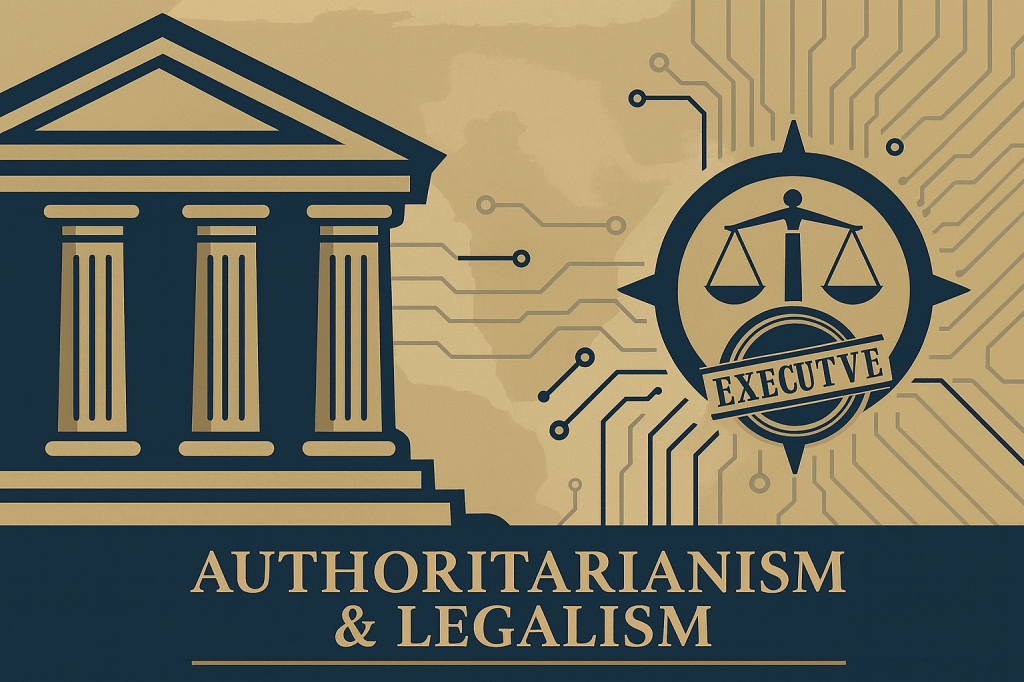
My research examines how authoritarian regimes rule through law—governing by legality, converting law into a technology of rule, and ultimately weaponizing it. Drawing on Weber’s account of rational–legal authority, Schmitt and Agamben’s state of exception, Bourdieu’s juridical field and symbolic power, Gramsci’s hegemony, Foucault’s governmentality, and Mbembe’s necropolitics, I view law not as a neutral shield but as a political technology embedded in social and political relations.
Using historical sociology and legal–political analysis, I examine how constitutions, emergency and counterterrorism statutes, and exceptional courts legalize repression, centralize executive authority, and reorganize coercive institutions. This agenda extends to digital authoritarianism and “algorithmic legalism”—the fusion of surveillance infrastructures, data governance regimes, and automated decision systems that repackage political priorities as neutral procedure, reshaping policing, adjudication, information control, and oversight.
The project is structured around five research questions: (1) Under what political, institutional, and crisis conditions are exceptional measures juridified and normalized through constitutional design and jurisdictional engineering that centralize executive power while sustaining a façade of legality? (2) Which legal mechanisms—across administrative and criminal law, exceptional jurisdictions, and procedural rules—restructure coercive institutions and insulate them from oversight? (3) Through what professional and organizational practices do legal elites (judges, prosecutors, bar associations) and security agencies implement, negotiate, or contest rule-by-law in practice? (4) How do infrastructural tools—procurement trails, regulatory frameworks, platform governance, data infrastructures, and algorithmic decision systems—embed security imperatives as “neutral” procedure, reshaping policing, adjudication, and information control? (5) What early textual, institutional, and technical indicators (e.g., drafting patterns, jurisdictional reorganizations, procurement signals) anticipate consolidation—or, alternatively, openings for contestation?
Methodologically, I combine close reading and coding of constitutional texts, executive decrees, court records, parliamentary debates, and archival materials with analysis of regulatory orders and digital procurement. The goal is to specify how legality operates within authoritarian rule, identify early indicators of legal–institutional change, and assess the risks these arrangements pose for rights, accountability, and democratic design.