
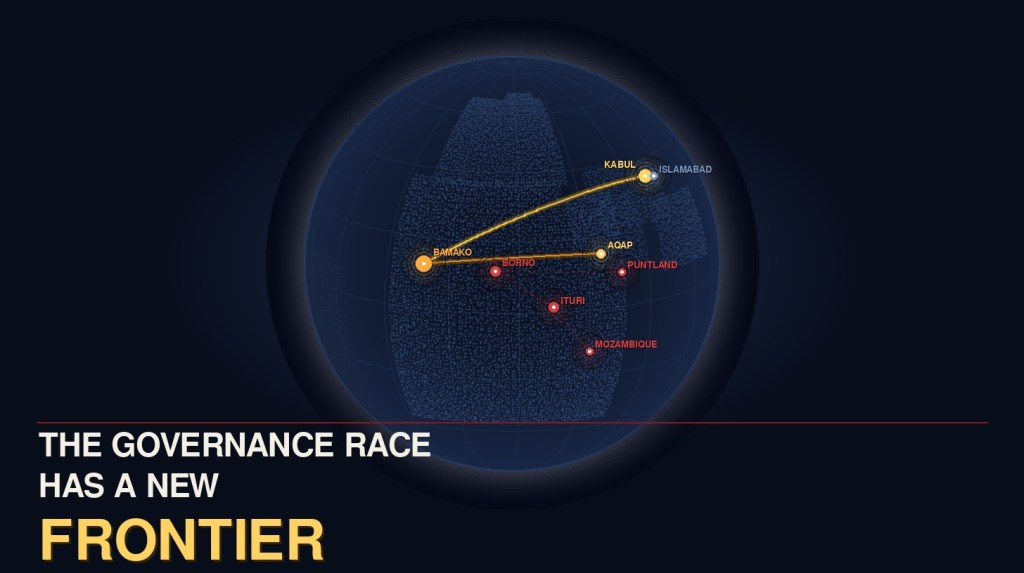
In last month’s BFTS issue, I argued that propaganda was best understood as a contest over authority rather than a competition over attack claims. Across ISIS, ISKP, the Islamic Emirate of Afghanistan, and al-Shabaab, the central question was not who struck hardest but who had the right to govern, adjudicate, administer, and define legitimate Muslim political action. That finding was the analytical headline of the April cycle.
Propaganda materials in May confirms that logic of authority and governance. More precisely, they extend the logic westward, intensifies the competition, and adds an actor that April lacked, a jihadist movement in the Sahel actively constructing the conditions for an Islamic emirate before one exists.
The governance contest is a structural feature of the current militant propaganda landscape. Reading April and May together, what emerges is not two separate monthly findings but a single longitudinal argument across at least two consecutive cycles. the primary arena of competition among jihadist and militant organizations is not the battlefield body count. It is the legitimacy claim — who can credibly govern, endure, punish, protect, and define Islam’s political future.
What May Adds
The April 2026 cycle documented three distinct theories of Islamic legitimacy operating simultaneously across different organizational contexts; governance as statehood, governance as insurgent administration, and governance as divine-law enforcement. None of these is a battlefield claim in the conventional sense. All three are claims to rule.
May 2026 does not simply repeat April’s finding. It introduces three developments that April could not have anticipated.
First, a new aspirant enters the governance field. Jamāʿat Nuṣrat al-Islām wa-l-Muslimīn (JNIM) — through aligned media outlets and AQAP’s formal endorsement — moved into the governance frame this month in a register that differs from all three April models. This is not governance as statehood, administration, or divine-law enforcement. It is governance as pre-legitimation which seeks to the construction of audience expectations for a political transformation that has not yet occurred.
An article published through Wakālat Shahāda al-Ikhbāriyya framed the Sahel explicitly as the site of an impending political replacement — an Islamic emirate emerging from the exhaustion of “client” governments, inherited colonial borders, and Western-backed state failure. AQAP made the analogy explicit. The liberation of Kabul is being repeated in Bamako and across the Sahel. That Kabul-to-Bamako comparison is analytically decisive. It is not rhetorical ornamentation. It is a deliberate framing device that anchors May’s Sahelian governance aspiration to April’s Afghan governance reality. AQAP is telling its audience: the model exists; it worked before; it is happening again.
JNIM’s own military communiqués provided the operational layer beneath this narrative. The group’s al-Zallāqa outlet released two statements in May. One claimed full control of the Hombori barracks in Douentza and two checkpoints near Bamako. The other — more analytically significant — reported that Malian army personnel at the Tinsalīt barracks in Gao had surrendered in exchange for safety guarantees and secure withdrawal, and invited other Malian soldiers to follow. This is not ordinary military communication. A group that offers formal surrender terms and presents itself as capable of enforcing those guarantees is performing a governance function — coercive administration — not merely military pressure.
Second, the IEA deepens its governance posture, shifting register. In April, the IEA’s primary legitimation instrument was defensive. The outrage over the Omid Hospital strike, converted into an argument about sovereignty, diplomatic maturity, and Afghan national dignity. Al-Ṣumūd 244 was anchored on victimhood transformed into statecraft.
May’s al-Ṣumūd (Issue 245) is different. The cover story concerns Afghanistan’s economic independence, highlighting some examples such oil extraction from five new wells in the Amu Darya field, projected 4 percent economic growth, the Qosh Tepa canal project, and a ban on interest-bearing finance. There is no dramatic incident driving the issue. The IEA is now presenting governance performance on its own terms — not as a response to Pakistani aggression but as a proactive demonstration of Islamic administrative capacity. This is a meaningful shift. In April, the IEA proved it deserved sovereignty by surviving attack. In May, it is proving it deserves authority by governing. The magazine also ran an explicit article positioning the IEA against the takfīrī excess that, in its telling, destroyed earlier jihadist projects — a direct response to ISKP’s April delegitimation campaign, and a signal that the Taliban is now actively managing its image within the Arabic-speaking Islamic public sphere.
Third, ISIS launches its most sustained intra-jihadist counter-campaign in the documented BFTS corpus. Five consecutive al-Nabāʾ editorials — Issues 545 through 549 — constitute a coordinated effort to contest every governance claim made by rival organizations. Issue 545 attacked al-Qaʿida/JNIM’s Sahel legitimacy, arguing that JNIM’s alliances with Azawad nationalist factions reveal ideological drift toward national politics rather than global jihadism. Issue 546 widened the attack to the Deobandi/Taliban-linked religious ecosystem in Pakistan, using the assassination of Muḥammad Idrīs — a Deobandi cleric and former parliamentarian killed near Bajaur — to argue that democratic electoral politics had been normalized within jihadist-adjacent seminary networks. Issue 547 converted the polemic into a recruitment argument, addressing foreign fighters in Syria — particularly Uzbek muhājirīn reportedly facing state pressure in Idlib — and framing them as men abandoned by nationalist revolutionary projects that used them and discarded them once the new order no longer needed them.
Issues 548 and 549 then pivoted from attacking rivals to internally forming the ideal ISIS subject. Issue 548 returned to the sacrificial fighter; Issue 549, published during the Hajj season, argued that tawḥīd is proven not through doctrine but through fighting, sacrifice, and media production. The editorial sacralizing of media workers — describing them as soldiers of tawḥīd whose deaths are analytically equivalent to battlefield martyrdom — is significant in its own right, but the broader arc matters more. After three issues contesting rivals, ISIS is rebuilding the affective and theological grammar of its own organization.
That arc — attack rivals, then rebuild internally — is not new in ISIS’s editorial practice. What is new is the intensity and specificity of the target. The five issues are not attacking a general landscape of “apostate” organizations. They are responding, editorial by editorial, to the specific governance claims being made by al-Qaʿida-aligned and IEA-aligned actors in the same month’s news cycle. ISIS reads what its rivals publish. The editorial campaign is a direct response to the governance pre-legitimation visible in the Shahada article and the AQAP statement. That makes it analytically useful as evidence. The polemical investment confirms that ISIS understands the governance contest to be real and consequential.
What to Watch
The Sahel will remain the most analytically active zone. Tracking three specific indicators would determine whether May’s pre-legitimation messaging marks a sustained campaign or a single-cycle emphasis. If JNIM’s al-Zallāqa outlet issues additional surrender-amnesty statements in June, that would indicate the group is institutionalizing coercive diplomacy as a governance function rather than treating Tinsalīt as an isolated incident. If AQAP or aligned outlets publish further releases invoking the Kabul-Bamako analogy, the pre-legitimation campaign can be treated as coordinated across the al-Qaʿida ecosystem rather than a one-off statement. And if al-Nabāʾ Issues 550–552 continue their anti-JNIM editorial line, ISIS’s counter-campaign can be confirmed as a sustained response rather than a momentary polemical outburst.
One other indicator matters beyond the Sahel. The IEA’s shift in al-Ṣumūd from defensive sovereignty to proactive governance performance should be tracked against al-Ṣumūd Issue 246. A second consecutive issue built around administrative and economic themes — rather than security crises — would confirm that the Taliban has deliberately repositioned its Arabic-language propaganda from crisis management to normalized statehood. That would be significant: not a governing movement defending itself, but a governing movement defining a model.
These are not predictions. They are specific, falsifiable indicators that would confirm or refute the longitudinal argument. If the pattern holds in June, the governance contest thesis moves from a two-cycle observation to an established trend requiring systematic tracking across the jihadist propaganda ecosystem.

