
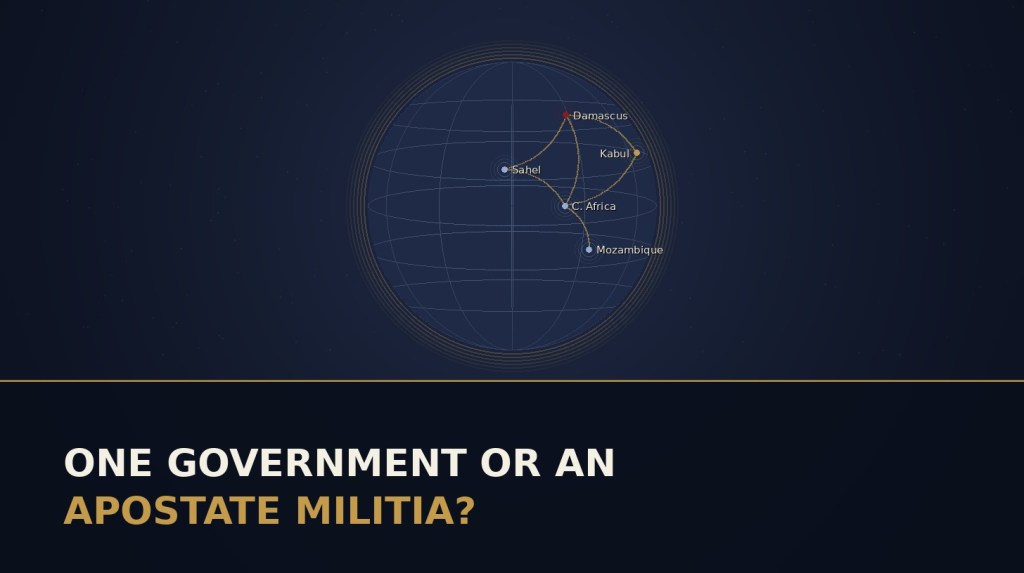
In the last week of July, the Islamic State’s weekly newsletter al-Nabāʾ reported the killing of the Taliban’s head of information and culture in Badakhshan province, and explained the killing in doctrinal terms. The man’s work — running schools, publications, and cultural policy — amounted to a war on Islam itself, which made him a legitimate target. The same month, the Taliban’s own monthly magazine, al-Ṣumūd, was making the opposite case to its own readers: that the Islamic Emirate of Afghanistan is a sovereign, religiously legitimate government, competently running railways, agriculture, and regional diplomacy while defending Islamic principles through what it calls “positive neutrality” toward competing world powers.
Neither publication mentions the other. But read side by side, they describe the same government in irreconcilable terms — one as a state, the other as a target. It’s tempting to talk about “jihadist groups” as though they form a single movement with one shared enemies list. July’s record says otherwise. The deepest fault lines in this landscape run between self-described Islamist actors themselves, not simply between them and the states or societies they attack. This isn’t one movement speaking with different voices — it’s a set of rival claimants, some running actual governments and some running weekly newsletters, each trying to prove that it alone represents real religious and political authority.
A Doctrine Unfolding in Stages
In July, al-Nabāʾ built a single argument in stages across five issues. The first two build a sustained case against Syria’s post-Assad political order. The newsletter’s editorial voice condemns the country’s newly formed parliament as an institution that “takes the representatives as lords besides God.” The following week extends the argument outward, attacking Damascus’s diplomatic opening toward France as a new form of foreign domination dressed up as partnership, and treating any government’s alignment with outside powers — Syria’s with France, the Taliban’s with Iran — as equally disqualifying under its doctrine of loyalty and disavowal.
Then al-Nabāʾ turns inward. The third issue tells existing fighters that persistence, not visible battlefield success, is the true measure of the movement’s legitimacy — a message that reads as an attempt to keep morale up after a week of claimed attacks noticeably lower than the one before. The fourth issue, published 23 July, escalates that argument into an explicit recruitment pitch: death, it says, is fixed regardless of what a person does, so fear of it protects no one, and readers are told directly to migrate and join the fight. The final issue of the month closes on a quieter, devotional note — patience, worship, and the idea that suffering itself erases sin and raises spiritual rank — while still applying that same argument from earlier issues in a very concrete way. It reports killing a Pakistani judge and warns that no judge who rules by secular law is safe from “the swords of the monotheists” until he adopts Islamic law. It is in this same issue that the Badakhshan claim against the Taliban official appears.
Treating these five issues as a single sequence — Syria first, morale second, mobilization third, consolidation fourth — makes the underlying argument clearer than any single issue does on its own: ISIS spent July arguing over which of the region’s competing Islamist governments and movements actually counts as legitimate, while working to keep its African fighters motivated through a difficult stretch.
Governance Is the Argument, Not a Side Issue
That argument is the real story of the month, and the Taliban is its clearest test case. Afghanistan’s rulers have spent the past several years trying to convert their battlefield victory into the ordinary business of running a state: infrastructure projects, functioning ministries, investment pitches, a seat at regional tables. Al-Ṣumūd’s July issue is built almost entirely around that project. Its lead article organizes Taliban foreign policy into six pillars — sovereignty, “positive neutrality” between competing powers, regional security cooperation, economic connectivity, prioritizing relations with neighbors, and counter-narcotics — and presents large infrastructure programs, like the TAPI gas pipeline and CASA-1000, as proof that Afghanistan has become a “connecting state” rather than a security problem.
For ISIS, this is precisely the kind of claim that cannot be allowed to stand unanswered. Its own legitimacy rests on the argument that sovereignty belongs exclusively to God, and that any human institution — a parliament, a judiciary, a ministry of culture — that claims to run public life on its own authority has associated a partner with God, the gravest sin in Islamic theology. Applied consistently, that argument does not stop at Damascus’s parliament. It extends to any government that behaves like a government — including one that also claims to rule by Islamic law. Al-Nabāʾ’s final issue of July did exactly that. The same editorial that reported killing the Badakhshan official recast his cultural work not as pious governance but as “nationalism” dressed up in religious language, and treated him as a combatant in an ideological war rather than a bureaucrat.
None of this is new — ISIS and the Taliban have been rhetorical and, at times, literal battlefield rivals for years, chiefly through the Islamic State’s Khorasan franchise. But it’s a reminder that “jihadist propaganda” is not one message broadcast on different channels; it is several competing claims to the same authority, and July’s most consequential development is not a single attack but the sharpening of that competition.
A Parallel, Less Visible Front: Recruiting Women and Veterans
Governance disputes were not the only thread running through July’s material. Two other releases, both published by Bayt al-Maqdis, work a different audience entirely. A trilingual magazine called Ibnat al-Islām (“Daughter of Islam”) moves without interruption between the suffering of Palestinian women prisoners and pages of recipes, breastfeeding guidance, and household management — building what reads as a portable identity for sympathetic women that does not require formal allegiance to any specific militant group. A second release, an undated Arabic pamphlet attributed to a writer using the name Abū Ḥudhayfa al-Sūdānī, addresses a narrower audience: veteran fighters who have stopped fighting because of age, injury, imprisonment, or family responsibility. Al-Sūdānī reclassifies that disengagement as a moral failure rather than an acceptable end to service, and calls on veterans to resume training younger recruits.
Neither text claims a specific attack. Both matter because they show recruitment operating on tracks separate from — and in the case of the unattached women’s magazine, potentially wider than — any single organization’s formal membership.
From Tactical Ledger to Campaign: JNIM’s Widening Claims in the Sahel
A third pattern this month had nothing to do with governance disputes or audience-building, and everything to do with how a group narrates its own momentum. Over the course of July, JNIM — the al-Qaeda-aligned coalition operating across Mali and Burkina Faso — issued three statements that escalate in scope with each release. The first reports a single ambush against Malian forces along the Gao–Annīf axis, with a promise of forthcoming evidence. The second, days later, compresses ten separate positional actions across multiple Malian sites into a single same-day operational ledger, as though the group were consolidating a week’s worth of activity into one show of reach. The third goes further still: a cross-border statement claiming coordination with the Azawad Liberation Movement, dozens of Malian and Burkinabe casualties, and — most notably — a downed Mi-24 helicopter with the loss of its Russian crew.
None of these claims carries independent corroboration, and the aviation claim in particular is the kind that would be significant if verified and easy to overstate if it isn’t. What is verifiable is the shape of the sequence itself. JNIM did not simply report three unconnected incidents this month; it moved, release by release, from a tactical after-action report toward something closer to a campaign story — a narrative of accumulating reach and coordination told across successive statements rather than contained within any single one. That progression is worth watching independently of whether any individual claim holds up, because it suggests a deliberate strategy rather than routine reporting.
Why This Matters
Seen together, al-Nabāʾ’s five-week arc, the Taliban’s diplomatic self-presentation, JNIM’s escalating claims in the Sahel, and the two mobilization pieces aimed at women and veterans are not separate stories loosely connected by subject matter. They are the same underlying condition playing out at different scales: an ecosystem in which authority is always contested and never settled, and in which every publication examined here — official or anonymous, governing or insurgent — is making its case to an audience that other publications are courting at the very same time. None of this month’s material ever addresses the others directly. None of it needed to. Each was simply doing what this ecosystem does by default: speaking as though no one else were talking at all.

