
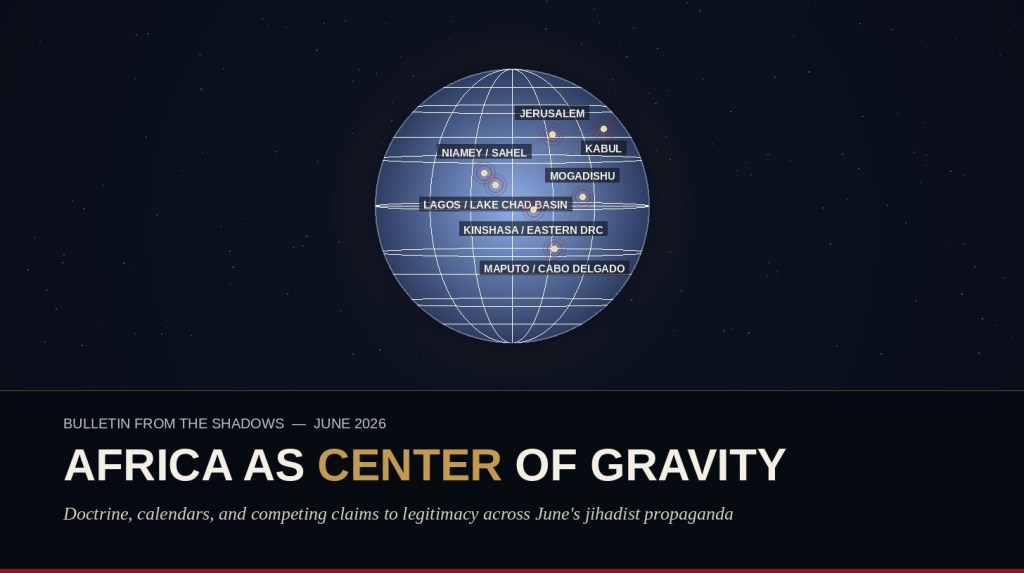
June’s jihadist propaganda record does not simply repeat familiar talking points. Read together, this month’s materials show a set of actors recalibrating their narratives around three shared axes: Africa as a strategic center of gravity, loyalty and disavowal (walāʾ wa‑barāʾ) as an everyday governing idiom, and competing visions of Islamic governance and rights. What looks like routine media output at the level of single statements becomes, in aggregate, a contested conversation about where jihadist projects locate their future.
Africa, Calendars, and ISIS’s Edited Story of Relevance
Across June’s four issues of al‑Nabāʾ (550–553), ISIS pivots decisively away from the comparative governance framing that anchored its April–May cycles, in which ISIS tried to outbid rivals on provision of order and social services. Instead, Africa appears again as the central stage on which the organization narrates both its past and its future.
Issue 550’s editorial, “Africa between yesterday and today”, traces a decade‑long arc from an early Iraqi video (Furṣān al‑shahāda) calling for support to African Muslims to the current claims of high‑tempo operations across West Africa, Central Africa, Mozambique, the Sahel and Somalia. Christians, once described as unpunished perpetrators of massacres, are recast as the new “persecuted,” groaning under the “swords of tawḥīd,” while infographics detail dozens of attacks and more than a hundred casualties in a single week. Africa is no longer peripheral; it is narrated as the place where ISIS has imposed “respect” through sustained violence.
Issue 551 turns inward, devoting its editorial to an extended exegesis on ṣabr (patience) and yaqīn (certainty). Fighters are warned against association with the “poor in certainty,” told that trials and wounds across the Umma should be read as divine tests rather than refutations of God’s promise, and reassured through dense Qurʾānic citation that perseverance is itself proof of legitimacy. The operational pages still foreground African theaters, but the textual emphasis shifts to managing morale.
Issue 552, “Who Will Be Crowned With the Title?”, is the cycle’s most policy‑consequential piece. Here ISIS reframes a major international sports tournament hosted across eleven U.S. cities as a “season of jāhiliyya,” a “Cup of trash” held “in the heart of Crusader America,” and uses walāʾ wa‑barāʾ to cast fandom—cheering for national teams, imitating celebrity players—as impermissible loyalty to armies steeped in Muslim blood. That doctrinal move becomes the bridge to a specific, dated call for lone‑actor attacks. The “isolated fighter” in host cities is instructed toward crowd‑ and venue‑directed stabbing, vehicle‑ramming, and arson during a bounded month‑long window.
Issue 553 then synthesizes these strands in a doctrinal manifesto opening the new hijrī year, pairing claimed Sahel base overruns in Niger with a systematic rejection of “peaceful change,” democracy, nationalism, “coexistence” and “humanity” discourse. Jihād, hijra, ḥākimiyya and walāʾ wa‑barāʾ are packaged as the only valid path; rights language and pluralist vocabularies are explicitly framed as an “intellectual war” aimed at dissolving Islamic belief.
Taken together, the June al‑Nabāʾ corpus describes an organization trying to defend its future by rooting relevance in Africa, manage its present by talking its fighters through a difficult year, and probe for openings by converting Western cultural calendars into repeatable opportunity structures. None of those moves are fully visible at the level of a single issue; they emerge only in the sequence.
Intra‑Movement Dissent and Migrant Protection in Syria
If ISIS’s June materials concentrate on theaters and calendars, other actors focus on internal accountability and the ethics of dissent. A short Arabic letter from an Uzbek muhājir network in arḍ al‑Shām, under the title “From Your Brothers, the Uzbek Migrants”, is a case in point.
The text defends a group of French muhājirīn who had released “The Legitimate Alliance” and were subsequently threatened and allegedly attacked with heavy weapons by individuals “claiming to belong to the government.” In their own account, the French migrants did not take up arms against Muslims or participate in destructive factional infighting; they “spoke with their tongues,” narrating abuses they had witnessed and exercising the right of commanding right and forbidding wrong.
The Uzbek group grounds this defense in canonical narratives of ruler accountability. They invoke an anecdote of ʿUmar b. al‑Khaṭṭāb inviting his audience to correct his “crookedness, even with swords,” to normalize robust critique of leaders as a divine blessing. They cite ḥadīth on God aiding those who aid their brothers and on the supreme martyrdom status of the man who confronts an unjust imam, explicitly stating that they and “many mujāhidīn” hope for the same reward. Islam, they insist, “has never been a religion of silence in the face of injustice,” but one of justice, sincere counsel, support for the oppressed and “the word of truth,” even when its price is affliction.
What emerges is a normative vision of muhājir networks as principled whistleblowers committed to neutrality in internal disputes, sacralizing dissent against local authorities without naming those authorities or calling for armed rebellion. In the June ecosystem, this is one of the clearest articulations of intra‑movement accountability as a religious duty rather than a deviation.
Al‑Shabāb: Jerusalem, Abraham Accords, and the Horn of Africa
June’s corpus also records a sophisticated attempt to link East African insurgency to Palestinian politics and normalization debates. Ḥarakat al‑Shabāb al‑Mujāhidīn’s communiqué “Jerusalem Will Not Be Judaized” is a doctrinal and political statement that treats the Horn of Africa as part of the same Zionist–Western architecture typically associated with Gulf and North African arenas.
The release condemns the “Zionist entity” for recognizing the “Somaliland Administration” as an “independent state,” joining the Abraham Accords framework and deepening security cooperation with Israel and Western actors. It denounces the administration’s president as an apostate and, citing Ibn al‑Munḏir, insists that “the disbeliever has no guardianship over a Muslim in any circumstance.” Qurʾān 9:71 on believers’ mutual alliance and 12:21 on God’s dominance over His affair are marshalled to affirm transnational solidarity and divine sovereignty over events.
Al‑Shabāb explicitly addresses “our brothers in Palestine” and “our people in Gaza,” insisting that Somalia’s Muslim population “stands alongside the Palestinian people” and that the group’s fighters in East Africa shed their blood “in the path of God” under the slogan “Jerusalem Will Not Be Judaized”. The cause of Palestine, they argue, is the cause of the entire Umma, not of Gaza alone; combat in East Africa is narrated as both a struggle to establish sharīʿa locally and a contribution to the eventual liberation of Bayt al‑Maqdis.
The move is symbolically ambitious. A Horn of Africa insurgent group claims guardianship over Jerusalem, uses Abraham Accords geopolitics to connect Somali separatist dynamics to normalization in the Middle East, and anchors its position in classical fiqh and shared‑blood formulas (“your blood is our blood, your cause is our cause, your enemy is our enemy”). Within June’s wider pattern, it sits alongside ISIS’s Africa‑centered narrative as part of a broader effort to reframe “peripheral” theaters as central to emblematic jihadist causes.
Competing Governance Projects: Taliban vs. ISIS
June’s materials also make visible an important doctrinal fault line in Sunni Islamist governance. Issue 246 of Majallat al‑Ṣumūd, the Taliban’s Arabic‑language magazine, combines an Eid al‑Aḍḥā message from Amīr al‑Muʾminīn Hibat Allāh Akhundzāda with a speech to a Russia‑hosted regional security forum. In that dual register, the Islamic Emirate continues to present itself as a stabilizing authority that has ended “decades of occupation, war, and unjust aggression,” contained ISIS‑K, and now protects citizens’ rights—including those of the poor, orphans, disabled people and returnees—through sharīʿa courts.
The vocabulary is explicitly rights‑inflected: citizens rights, care for vulnerable groups, assurances of safety for returnees, all framed as outcomes of “full implementation of sharīʿa” under Taliban rule. The Russia‑forum speech situates Afghanistan as a partner in regional security, open to balanced relations with neighbors and global powers while insisting on non‑interference and Islamic identity.
Juxtaposed with ISIS’s June editorials, which attack “humanity” and “coexistence” discourse as an “intellectual war” and treat rights language as a gateway to apostasy, the Taliban’s line is striking. Both actors invoke sharīʿa and ḥākimiyya; both claim to be implementing divine law. But one uses rights and stability to seek recognition; the other insists that perpetual confrontation and refusal of pluralist norms are the only proofs of authenticity.
For analysts and policymakers, the distinction matters. Treating these projects as interchangeable “Sunni Islamist threats” misses the fact that their audiences, incentives and desired forms of legitimacy diverge sharply. It also obscures opportunities to exploit doctrinal tension between rights‑based sharīʿa governance and anti‑“humanity” maximalism in counter‑messaging and diplomacy.
Gaza and Transnational Martyrdom
A brief Jaysh al‑Ummah communiqué from Gaza rounds out the month’s picture by highlighting how scholarly figures anchor transnational solidarity even when groups do not share territory or primary enemies. The statement, issued under the label “Jaysh al‑Ummah fī Bayt al‑Maqdis”, offers condolences on the “martyrdom” of Dr. Sāmī al‑ʿArīdī, former chief sharʿī for Jabhat al‑Nuṣra and a leading ideologue for Ḥurrās al‑Dīn.
The text frames al‑ʿArīdī’s death in a U.S.-led coalition strike in Idlib as istishhād, praises him as a mujāhid, and directs solidarity to his comrades in al‑Shām and to the broader al‑Qaʿida‑aligned camp. Even in a short taʿziya, the act of public recognition matters; a Gaza‑based Salafi‑jihadi group signals its place within a transnational doctrinal network by mourning a Syrian Jordanian ideologue, reinforcing the shared pantheon of “ʿulamāʾ al‑jihād” that cuts across organizational and geographic boundaries.
In the June ecosystem, this is a reminder that propaganda is not only about operations and theaters; it is also about maintaining a common symbolic repertoire of martyrs and scholars through which disparate nodes—Gaza, Idlib, Sahel—recognize one another.
Cross-Cutting Themes and What They Tell Us
Viewed as a whole, June’s militant propaganda is neither a unified front nor a random assortment of texts. Several cross‑cutting patterns stand out across ISIS, al‑Shabāb, the Taliban, muhājir networks and Gaza‑based actors.
First, walāʾ wa‑barāʾ and adjacent notions of loyalty and disavowal are everywhere. ISIS names the doctrine explicitly and extends it from alliance politics into leisure, fandom and global normative discourse. Al‑Shabāb implicitly invokes it in its rejection of non‑Muslim guardianship and its insistence that Somalis and Palestinians share blood, cause and enemies. The Uzbek letter mobilizes a related ethical universe in which support for oppressed muhājirīn and the “word of truth” against unjust rulers become devotional acts. Together, these texts show how a doctrinal lens migrates from high politics into everyday policing of taste, speech and internal dissent.
Second, Africa is consistently framed as a decisive theater rather than a periphery. ISIS uses Africa to prove operational vitality and moral superiority; al‑Shabāb uses the Horn of Africa to talk about Jerusalem and Abraham Accords; Sahel raids in Niger are presented as opening the new hijrī year with proof that “rizq lies under the shade of the spear.” That shift deserves to be taken seriously. Continental African arenas are now central to how each of these actors narrates its future, not a subplot to conflicts elsewhere.
Third, Sunni Islamist governance is not a single project. The Taliban’s rights‑inflected al‑Ṣumūd narrative, ISIS’s anti‑“humanity” manifesto, al‑Shabāb’s anti‑guardianship polemic, and migrant letters about ruler accountability all claim sharīʿa legitimacy while pointing in different directions on rights, recognition and violence. Treating them as variations on one theme flattens a field whose internal divergence is precisely where research, policy, and counter‑messaging have room to work.
Finally, June’s record suggests that militant groups are not only responding to immediate tactical pressures; they are also thinking in terms of cycles and calendars. From ISIS’s editorial sequencing and its call to map “seasons of kufr” for future exploitation, to al‑Shabāb’s use of Abraham Accords timelines, to the Taliban’s pairing of Eid messaging with regional security fora, this corpus reveals actors attempting to synchronize their media with global and Islamic temporalities.
An Ecosystem Recalibrating, Not Repeating
June 2026 is not a static inventory of threats; it is a snapshot of several militant projects mid-argument about where legitimacy, danger, and opportunity now lie. ISIS’s pivot from governance-competition rhetoric toward an Africa-rooted narrative of relevance, paired with a dated, calendar-specific call to violence against a Western sporting event, suggests an organization simultaneously defending its long-term claim to significance and probing for short-term openings — a combination that repays close, continued attention rather than a one-off flag.
Two implications for readers tracking this space. First, the specific and bounded nature of ISIS’s tournament-linked incitement means security planning in the relevant host cities should treat it as a discrete indicator, distinct from — and not diluted by — the broader African operational narrative running in parallel. Second, the doctrinal daylight opening between the Taliban’s rights-inflected governance claims and ISIS’s explicit rejection of pluralist vocabulary is not a minor footnote. It is a genuine fissure in the wider jihadist field, one that counter-messaging and diplomatic engagement are better positioned to exploit the more clearly it is understood as a fissure rather than a family resemblance. What ties these threads together is not coordination but a shared sense, across otherwise unconnected actors, that the coming months call for a renewed argument about where violence belongs and whose loyalty it requires.

