
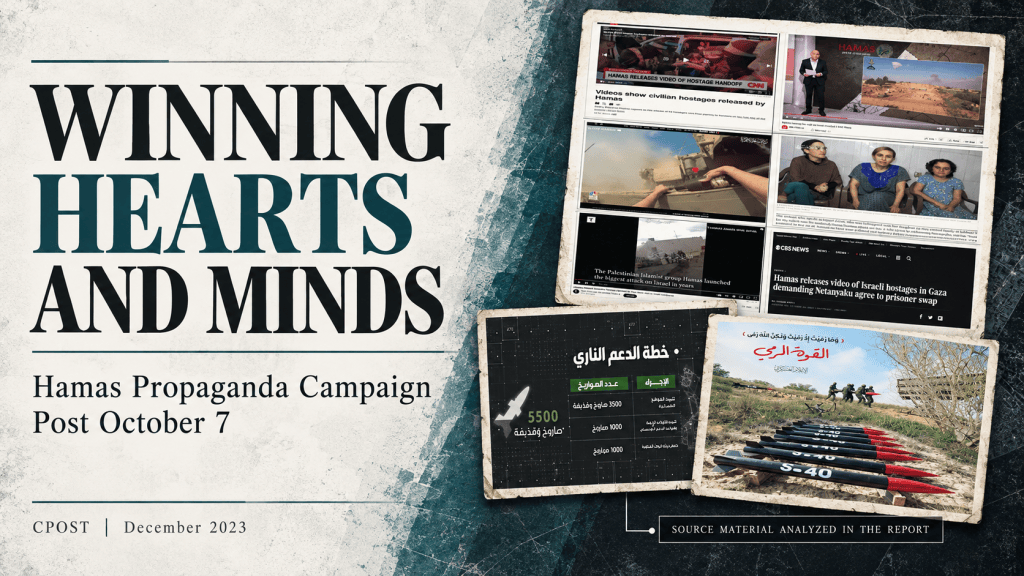
This report provides an in-depth examination of the sophisticated propaganda campaign orchestrated by Hamas and its military wing, the Al Qassam Brigades in the aftermath of the events of October 7 – the first such systematic and comprehensive analysis of Hamas propaganda in this period. It covers over 1300 Hamas videos and other materials – all in Arabic – posted on the group’s various Telegram channels from October 7 to December 3, 2023. It offers an unparalleled window for American, European, and other non-Arabic speaking audiences into how Hamas thinks it can win hearts and minds.
The propaganda efforts of Hamas and the Al Qassam Brigades are multifaceted and strategically designed to achieve four key objectives: the legitimization of the October 7 attacks, the demonstration of their military capabilities, the cultivation of regional and international support, and the portrayal of the group in a sympathetic light while simultaneously casting Israeli actions in a negative context. The report is a detailed analysis of these strategic components, offering insights into the methods employed by Hamas to effectively utilize propaganda. It explores the intricate ways in which Hamas seeks to influence and shape both regional dynamics and international perspectives. Through a careful dissection of their propaganda tactics, the report aims to provide a nuanced understanding of how Hamas leverages media and communication tools to further its objectives, navigate its political landscape, and impact public opinion on a global scale.
Topline Findings
First: Hamas Propaganda Production: Hamas has maintained a prolific output of video and other propaganda materials, even amidst the intense constant Israeli airstrikes and ground invasions. From October 7 to December 3, the official Al Qassam Brigades Telegram channel has been notably active, producing approximately 26 videos and visual pieces on a weekly basis. The content predominantly showcases the group’s military capabilities, reflecting a strategic emphasis on demonstrating strength and resilience. Concurrently, an unofficial channel associated carrying the same logo and name of the official channel has been disseminating an average of about 139 propaganda materials weekly.
The focus of these materials is markedly different, centering primarily on the civilian casualties and the suffering experienced by Palestinians. This dichotomy in content between the official and unofficial channels highlights a multifaceted approach to propaganda, wherein one avenue emphasizes military prowess and the other underscores the humanitarian impact of the conflict. This dual strategy appears to be aimed at appealing to different audiences and shaping perceptions on multiple fronts.
Second: Primary Content in Hamas Propaganda: Official Hamas content predominantly focuses on showcasing the combat successes of the Al Qassam Brigades. This emphasis diverges from the commonly held assumption that such propaganda would primarily center on religious justifications. In the period from October 7 to December 3, the spokesperson for Al Qassam makes regular appearances, averaging twice a week, which constitutes approximately 9% of the total propaganda materials. These appearances are primarily dedicated to providing updates on combat situations, highlighting the successes of Al Qassam fighters on the battlefield, and detailing the losses incurred on the Israeli forces and their weaponry.
Furthermore, about 44% of the videos released during this period are dedicated to showcasing ongoing military operations against Israeli forces, underscoring a strategic focus on military prowess rather than religious rhetoric. Additionally, approximately 19% of the content focuses on demonstrating the successful development of weapons by Al Qassam, such as rockets, suicide drones, and shells. These segments specifically highlight the effectiveness of these armaments against Israeli forces. This aspect of the propaganda underscores Al Qassam’s emphasis on technological advancement and military capability as key components of their strategic narrative.
Finally, Propaganda Reach and Dissemination: Despite disruptions, Hamas has adeptly navigated these challenges and successfully disseminated its materials and messaging through online channels that have been amplified by mainstream media. For obvious reasons, the dissemination and reach of Hamas propaganda, particularly in the context of its online presence, have faced significant challenges due to various restrictions. Hamas and its military wing have encountered substantial limitations in accessing digital platforms. Their official websites have been difficult to access, and their social media accounts across various platforms, including Facebook, Instagram, TikTok, and others, have been suspended. Despite these constraints, Hamas has been able, virtually continuously, to disseminate its materials and messaging through alternative channels. One such effective medium has been Telegram, a platform that has provided a more resilient and less regulated space for their communications. Moreover, the reach of Hamas’s propaganda extends beyond these direct channels. It has found a significant audience in mainstream media, encompassing both Western and Arabic media outlets. This coverage in mainstream media has played a crucial role in amplifying Hamas’s messages, providing them with a broader platform that compensates for the restrictions encountered on social media and other online platforms.

